Category: Cholesterol

  • Statin Drugs Found To Cause Increased Parkinson’s Risk

    This is Part IX of a multi-part series that discusses the statin drug controversy. Please find links to the rest of this series at the end of this article.

    By Nurse Mark

    StatinWarning


    Dr. Myatt and I have been warning of the dangers of statin drugs for many years.

    Are we totally against the use of these drugs? Of course not!

    Like most drugs, there are times when the use of statin drugs can be life-saving – but they are rare.

    For most people, a prescription for a statin drug is more about making the doctor feel good and making the shareholders of the drug companies happy.

    In our previous articles we have alluded to an increased risk of Parkinson’s occurring with decreased cholesterol levels, and that normal to higher cholesterol levels are protective from Parkinson’s. Now, research data from a surprising source is showing that people taking statin drugs are at an increased risk of developing Parkinson’s. This is in direct opposition to earlier studies that had show a weak protective effect from statins against this feared disease.

    So, why is this new data so surprising?

    Well, most medical research studies of this sort rely on the review of medical records, or patient surveys or questionnaires as the source of data. This study relied on a data source far larger and possibly much more accurate.

    Why more accurate? Well, is there anyone more accurate and precise and careful than an actuary for an insurance company? These are the people who use their data to predict, almost eerily sometimes, the life expectancy and causes of death of the people they insure. They are spooky accurate – they have to be – since the profitability of the insurance company relies on their skills at predicting these things.

    Dr. Xuemei Huang, MD, PhD, vice chair for research at Penn State College of Medicine, in Hershey, Pennsylvania decided to mine this mother lode of detailed information in order to do her research. She and her team looked at data from the MarketScan Commercial Claims and Encounters database, an incredible 30,343,035 people aged 40 to 65 years between January 1, 2008, and December 31, 2012 and found that out of those over 30 million people 21,559 had a diagnosis of Parkinson’s disease.

    When they looked at the data for those 21,559 people with Parkinson’s they found the use of cholesterol-lowering drugs, including both statins or nonstatins, was associated with a significantly higher prevalence of Parkinson’s disease. As they further refined their analysis they found that both statins and nonstatin cholesterol-lowering drugs were associated with Parkinson’s disease, but over time only statins remained significantly associated with increased Parkinson’s risk.

    Now the question must be asked: Is it the higher cholesterol that protects from Parkinson’s, and that protection is being taken away by the drugs, or is it something about the drugs themselves that is causing this increased risk for Parkinson’s?

    "We know that overall weight of the literature favors that higher cholesterol is associated with beneficial outcomes in Parkinson’s disease, so it’s possible that statins take away that protection by treating the high cholesterol," Dr Huang explained.

    "Another possibility is that statins can block not only the cholesterol synthesis but also synthesis of coenzyme Q10 that is essential for cell function."

    We have warned for years that anyone taking statins must (not just should – must) be supplementing a high quality CoQ10. Even conventional medicine has conceded that statins deplete CoQ10.

    Dr. Huang went on to explain:

    "The increased risk of Parkinson’s is more likely when statins are first used, so we think it could be that the statins ‘unmasked’ Parkinson’s," Dr. Huang said. "Namely, people may be already on the way to Parkinson’s and when they use statins to control the high cholesterol, it gives Parkinson’s a push to reveal its clinical symptoms.

    "Based on this data, we think caution should be taken before advancing statins to be protective of Parkinson’s disease," she added. "The data are not clear yet."

    While Dr. Huang, in her abundance of scholarly and scientific caution, says the data are not clear yet, it is clear enough for us here at the Wellness Club.

    In our opinion, statins certainly may have a place in the treatment of some people with certain high cholesterol conditions. We also believe that conventional medicine, at the urging of Big Pharma, has set unhealthy low levels for cholesterol, leading doctors to vastly over-prescribe this potentially dangerous drug.

    Until more is known about the statin / Parkinson’s relationship we would urge anyone with Parkinson’s disease, or with a family history of PD to think very, very carefully about using a statin drug.

    And of course, no one should ever use a statin drug without supplementing with CoQ10.


    Part VIII can be found here: Statin Drugs: The Evil Of A 20 Billion Dollar Industry

    Part VII can be found here: Statin Drugs Proven To Increase Risk Of Cataracts

    Part VI can be found here: Statins Proven To Cause Increased Injuries

    Part V can be found here: Saturated Fats Are NOT Bad For You – Here’s PROOF

    Part IV can be found here: Cholesterol: Life-Giving Or Life-Threatening?

    Part III can be found here: New Research Into Statin Drug Memory Loss

    Part II can be found here: Trade Your High Cholesterol For Diabetes!

    Part I can be found here: Lower Your Cholesterol – Lose Your Marbles?

    References:

    Medscape Medical News, Statin Use Linked to Increased Parkinson’s Risk, Nancy A. Melville, October 26, 2016
    http://www.medscape.com/viewarticle/870996
  • That Fried Stuff’ll Kill You! Right?

    By Nurse Mark


    Everybody knows that all those fried foods are bad for you, right?

    Well, not so fast… It turns out that not all fried foods are created equal. Some fried foods are bad for you – really, really bad while others may even be good for you. It turns out that it’s all about how and what they were fried in.

    We have talked many times before about the differences in oils, and especially in cooking oils. Polyunsaturated Fatty Acids (PUFAs) are the real culprit here, despite the incessant preaching of the powerful Edible Oils industry.

    You see, beginning back in the ‘60’s and ‘70’s, we have been bombarded with slick ads telling us how wonderful and healthy canola oil, corn oil, cottonseed oil and other similar PUFAs were for us. Living longer, having a healthy heart, growing smarter children, smelling better in your kitchen, leading you to spiritual enlightenment, and so on.

    Your mom and mine knew no better – they saw the ads on TV and they believed them – after all, it was the same TV that brought the truth by Mike Wallace and Walter Cronkite, right? So began the near-religious belief that Crisco is better than lard, and that margarine is better than butter, and that corn oil or canola oil is so much better than coconut or palm kernel oil for deep frying…

    Well, what the edible oil industry failed to mention was that their PUFAs are fragile – even just processing them can damage them, turning them rancid; turning them into trans fatty acids or “trans-fats.”

    They also forgot to mention that even if these wonder-oils manage to make it to you relatively undamaged, heating them, as you might when you fry with them, promptly alters their structure – oxidizing them, creating free radicals, toxic lipid peroxides, carcinogens and mutagensOxygen and heat cause PUFA oils to form much more of these toxins than what’s found in saturated or monounsaturated oils.

    Finally, in all their preachy advertising, these big Edible Oil manufacturers conveniently forget to tell us that besides the rancidity caused by heat and oxygen,  PUFAs have another problem: They are inflammatory, because of their high Omega 6 content. That “Heart-Healthy” butter-like spread you just slathered on your whole wheat toast may actually be contributing to the subtle body-wide inflammation that is contributing to the atherosclerosis that your doctor wants to give you drugs for!

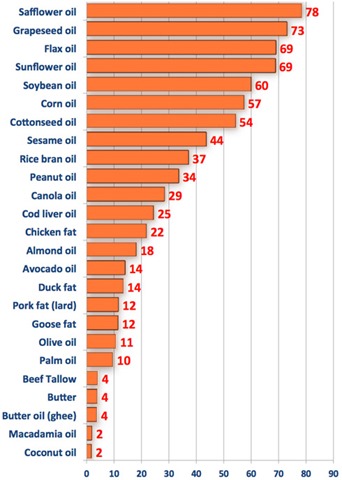
    Here’s a look at the PUFA content of commonly used cooking oils: (Source: USDA Nutrition Database.)

    Omega-6-and-Omega-3-Polyunsaturated-fatty-acid-content-of-food-oils


    Looking at this list it is easy to see that the much-reviled “saturated fats’ like butter, beef tallow, and coconut oil contain very little of the potentially toxic PUFAs. Of course they do – they are saturated fats. Because they are “saturated” they are highly heat stable, and not easily damaged or turned rancid.

    So, where is all this leading to?

    To the conclusion that perhaps deep fried foods need not be unhealthy – if they are cooked carefully, using oils low in PUFAs.

    Unfortunately, research published in 2010 shows that the most common commercially used deep frying oil is not healthy coconut, or even the less-expensive but still healthy palm oil, it is corn oil – often blended with soybean or safflower oil.

    Worse, restaurants reuse their oil over and over and over – reheating it each day anew, and occasionally filtering out the chunks – but the toxic trans fats cannot be “filtered out” and they just keep building up until the oil becomes so damaged and rancid that it begins to affect food flavors and the restaurants must reluctantly throw it away, fit only for use as “Bio-Diesel” fuel.

    Readers, you can do better – much better.

    You have the choice when you cook (and yes, frying and deep-frying ARE healthy cooking choices) of using a health-safe cooking oil such as coconut oil or butter or beef tallow.  Want to know the secret to the tastiest French fries you have ever encountered? Beef tallow – a chef’s “secret”!

    Even if you insist on using corn oil, using it once at relatively low heat and then discarding it can be safe.

    Well then, let’s suppose for a moment that I have persuaded you that deep-fried is not necessarily synonymous with poison (if done right) yet you are still worried by all those warnings about the artery-clogging effects of evil saturated fats. (If you really do believe this, please take a few minutes to read our article “Saturated Fats – Another Big Fat Lie”)

    Wouldn’t it be great if there were a pill that could mitigate all the ill effects of saturated fats and make it OK to indulge – maybe even good to indulge?

    Well, it turns out that such a pill might not be entirely fantasy.

    Scientists are researching a substance called alphacyclodextrin, a soluble fiber derived from corn. This novel fiber has shown promise for its ability to preferentially adsorb and bind up both saturated and polyunsaturated fats, while leaving valuable Omega 3 and Omega 6 fatty acids relatively unaffected.

    Results of recent research are very positive, with researchers concluding that the substance:

    “…has beneficial effects on weight management in obese individuals with type 2 diabetes, and that it preferentially reduces blood levels of saturated and trans fats…”

    And

    “These results suggest that α-CD [alphacyclodextrin] exerts its beneficial health effects on body weight and blood lipid profile in healthy non-obese individuals, as previously reported in obese individuals with type 2 diabetes.”

    Does this sound too good to be true? Possibly – which is why Dr. Myatt has not chosen to make it available to you just yet. She is researching it intensively though, and as soon as she is convinced of the safety and efficacy of the substance, and of her ability to offer you a pure, potent, top-quality product she will consider making it available.

    So, stay tuned!

    References

    learn more about coconut oil: https://www.drmyattswellnessclub.com/CoconutOil.htm

    Deep Fry Oils in commercial use; Jahren, A. Proceedings of the National Academy of Sciences, published online Jan. 18, 2010. http://www.pnas.org/content/107/5/2099.full

    Alphacyclodextrin research: Comerford KB, The beneficial effects of α-cyclodextrin on blood lipids and weight loss in healthy humans. Obesity, 2011 Jun;19(6):1200-4. doi: 10.1038/oby.2010.280. Epub 2010 Dec 2. http://www.ncbi.nlm.nih.gov/pubmed/21127475

  • Statin Drugs: The Evil Of A 20 Billion Dollar Industry

    By Nurse Mark


    Follow The Money

    StatinWarning


    If you ever want to know how or why something bad happens, just follow the money.

    Anything that is worth 20 billion dollars a year is sure to have players involved that are careful in safeguarding their interests. Silly, inconsequential things like “the public good” have no place in such industries.

    The money is everything.

    And so it’s no surprise that research critical of something as profitable as statin drugs rarely ever sees the light of day.

    Researchers that dare to challenge the statin industry often find that their next research project is more along the lines of personally discovering the joys of flipping burgers on the late shift. You can be sure that there will never be grant money again for such rebels

    We have written before about the dangers of statin drugs and the near-religious fervor with which statin proponents in Big Pharma and Big Medicine (which are really one in the same) protect this cash-cow drug.

    Buried Research


    Here is a research paper that we are betting you’ll never hear about anywhere else.

    Two researchers in Ireland mined the conventional medical literature sources of Pubmed, EMBASE and the Cochrane review databases for articles about cardiovascular care and statin side effects. What they found was not pretty.

    Their paper, titled “The Ugly Side of Statins. Systemic Appraisal of the Contemporary Un-Known Unknowns” concludes (in part):

    These finding on statin major adverse effects had been under-reported and the way in which they withheld from the public, and even concealed, is a scientific farce.

    Ouch!

    Some Of Their Findings:

    For every 10,000 people taking a statin, there were:

    • 307 more patients with cataracts
    • 23 additional patients with acute kidney failure
    • 74 extra patients with liver dysfunction


    Playing the percentages:

    • statin therapy increased muscle fatigue by 30%
    • statin therapy at higher doses resulted in rhabdomyelosis in 11.3% of users


    Be Afraid Young Man!


    Nothing strikes fear into the heart of a young man (or a man at any age) more than erectile dysfunction, which was found to be 10 times more likely to occur in young men taking even the lowest dose of statin drugs.

    The ray of sunshine? When statins were stopped over 50 percent had full recovery within 6 months.

    The others? Good question…

    It’s A Choke


    While searching through the FDA Adverse Event Reporting System database the researchers found that for every 10,000 reports of a statin-associated adverse event, approximately 40 reports were for statin-induced interstitial lung disease – a condition that can lead to devastating, even deadly, Pulmonary Fibrosis.

    This Is Not So Sweet


    The U.S. Veterans Affairs healthcare system is as “conventional” as they come. Still, a V.A. study on 15 million veterans in 10 hospitals in the southern US found that statins affect fasting and postprandial (after eating) glucose levels by causing hyperglycaemia (high blood sugar) in diabetic as well as non-diabetic patients.

    Another major study showed a significantly increased risk of developing hemoglobin A1c readings of greater than 6% in both diabetics and non diabetics.

    Other researchers have demonstrated that statin drug therapy can cause insulin resistance.

    Women, Heed This


    Another highly-regarded study, the JUPITER study, showed that statin therapy can cause full blown type 2 diabetes in women.

    A recent study from the Womens Inititative looked at 153 840 post-menopausal women without diabetes. Following these women over a number of years found that 10,242 developed diabetes.

    Statin use was associated with an increased risk of diabetes and this association remained after adjusting the data for other potential causes and it was seen with all types of statin medications.

    Senior Moments


    Researchers found that prescribing a statin to seniors increases their risk of developing diabetes by 9%.

    A Shaky Relationship


    Parkinson’s disease strikes fear into the hearts of seniors.

    A strong association between lower cholesterol levels and increased risk of Parkinson’s disease has been reported. Researchers found that each mmol/L increase in total cholesterol was accompanied by a 23% decrease in the risk of developing Parkinson’s disease.

    Interestingly, the risk reduction was significant in women but not in men.

    Statins And Cancer?


    One review found that statin therapy increased risk of non-melanoma skin cancers. Another researcher reported that long term statin use was associated with an increased risk of colorectal cancer, bladder cancer and lung cancer.

    Other evidence shows an association between the use of statin in patients after kidney transplant and increased risk of developing of squamous cell carcinoma.

    The researchers state that “For unknown reasons, since these publications the squamous cell carcinoma [information] has been excluded in all reports from subsequent statin trials. Hmmm…

    I See Problems Here…

    Cataracts are becoming increasingly common, and people are developing them at younger ages. Why?

    Research has found that statin drug users have a 50% probability of developing cataracts at an earlier age than non-statin users, who tend to develop them at a significantly later age.

    But This Takes The Prize!


    Statin drugs, given to us by Big Pharma with promises of preventing cardiovascular disease, actually have been found to increase the prevalence and the extent of coronary plaque calcification – a major component of cardiovascular disease.

    That’s right, a review of research data showed a strong association between statin use and the progression of coronary artery plaque. Oops…

    What’s more, The Veteran Affairs Diabetes Trial found that statin use was linked to accelerated progression of Coronary Artery Calcification (CAC) in participants with Type 2 Diabetes without previous coronary artery disease, despite the fact that the statin users had significantly lower and nearly optimal LDL-cholesterol levels.

    Could It Get Any Worse For Statins? Yes, Yes It Could.


    Statin drugs activate the Atrogen-1 gene which causes muscle atrophy, wasting and damage.

    The heart is a muscle – perhaps the most important muscle in your body!

    Statin induced cardiomyopathy (damage to the heart muscle) is the result of statin-induced coenzyme q10 deficiency and statin-induced Atrogen-1 activation.

    The Bottom Line?

    Cholesterol is crucial for energy, immunity, fat metabolism, leptin (the hunger/satiety hormone), thyroid hormone activity, liver health, stress tolerance, adrenal function, sex hormone synthesis and brain function.

    Do we really think it wise to tamper with our body’s own regulatory mechanisms in order to force our cholesterol levels to conform to some artificial standard?

    Perhaps we might be better served to address the causes for our epidemic of “metabolic syndrome” and “high cholesterol levels” that seem to have come along with it.

    Poor diet, lack of exercise, stress, toxins, all these things affect our finely balanced human system – what we medics call “homeostasis.”

    To learn more about how to help your body support healthy cholesterol levels, please visit our webpages discussing Self-Help for High Cholesterol here and here and be sure to read our previous HealthBeat News articles on both statin drugs and cholesterol.

    Learn more about the vital substance cholesterol in The Truth About Cholesterol Pt.I and The Truth About Cholesterol Pt.II

    Finally, has your conventional doctor used the words “ticking time-bomb” or something similar in trying to get you to accept a a prescription for a statin drug? Yes? Run, don’t walk, away from it! And contact Dr. Myatt for a Brief Telephone Conversation to learn what your options really are.


    Reference:

    This article is a synopsis for lay readers of an original research paper. The original paper is fully referenced and is available for review by interested readers:

    Sherif Sultan, Niamh Hynes: The Ugly Side of Statins. Systemic Appraisal of the Contemporary Un-Known Unknowns.
    Open Journal of Endocrine and Metabolic Diseases, Vol. 3  No. 3 (2013) , Article ID: 34065 , DOI:10.4236/ojemd.2013.33025

  • Headlines Scream: New Risks For Niacin!

    By Nurse Mark


    Will the assault on vitamins, minerals, and other natural and non-patentable (and thus non-profitable) supplements and treatments ever stop?

    In my opinion, no. As long as something poses a threat to the profit picture of Big Pharma and their patent drug offerings there will be no let-up in Big Pharma’s efforts to remove the competition.

    Here is a link to one of dozens of equally breathless and poorly researched and written articles from the last few days: Studies see new risks for cholesterol drug niacin

    Pretty scary, huh? Calling niacin a drug, invoking the names of a “famous” cardiologist and both the American Heart Association and the American College of Cardiology, telling us that just by using this “Drug” niacin "for every 200 people that we treat with niacin, there is one excess death,"…

    It sure sounds like we had better stop using this deadly “drug” immediately!

    Right?

    Not so fast…

    Associate Press (AP) and the reporter who penned this unfortunate scare-piece have done their readers a severe injustice – shame on them for such shoddy journalism!

    While the reporter correctly identifies niacin as a member of the B vitamin family, she promptly goes on to call it a drug, and then compounds her error by insinuating that patent drug forms of niacin-containing drugs offered by the pharmaceutical companies by prescription are no different from the natural forms of simple, unadulterated niacin available over-the-counter in your local health food or vitamin store. Shame on her!

    The drugs referred to in this “study” are Niaspan and Tredaptive. Both these drugs contain niacin – but niacin alone is not a drug – it is a vitamin!

    And bologna contains beef – but it sure isn’t steak!

    Niaspan is a “time release” niacin-containing drug from the drug company Abbvie. It contains it’s niacin in a wax matrix within a film coating that is said to delay absorption (the “time release” part) and it also contains the inactive ingredients hypromellose, povidone, stearic acid, and polyethylene glycol, and the coloring agents FD&C yellow #6/sunset yellow FCF Aluminum Lake, synthetic red and yellow iron oxides, and titanium dioxide.

    Niaspan has been around as a prescription drug for many years and has long been known to carry a risk of liver damage and to occasionally cause increased blood glucose in diabetics.

    Tredaptive is, so to speak, “a whole ‘nother ball-game” and one really has to question why it is even being mentioned. You see, while this fancy prescription drug does indeed contain niacin, it also contains another drug – a drug called Laropiprant which acts as a prostaglandin DP1 antagonist intended to reduce the natural  “flushing” that niacin is infamous for.

    So, why would I say that Tredaptive is “a whole ‘nother ball-game”? Well, because it has never been approved for use in the United States, it has been banned from use in Europe, and in those few countries where it is still available the drug company Merck is suspending sales of it and telling doctors to stop prescribing it!

    Sounds like a bad drug that Merck no longer wants to take a chance on selling – the risks are too great! Remember, Merck, like any drug company is all about risk and reward – aka “profit” – and they have obviously concluded that the profit from this drug will not be enough to offset the payouts when the lawsuits begin…

    Bad Science (aka B.S.), Bad Writing, and an obvious bias toward Big Pharma combine to give you…

    A terrible pseudo-news article intended to frighten you away from a natural vitamin and designed to help lay the groundwork for the FDA’s desired abolition of non-prescription vitamins, minerals and dietary supplements.

    The reporter is actually writing about an editorial (i.E.: “opinion”) article published recently in the New England Journal of Medicine by Dr. Donald Lloyd-Jones of Northwestern University in Chicago. This very same Dr. Donald Lloyd-Jones is a paid grand poohbah with the American Heart Association – an outfit very deeply in the pocket of Big Pharma, and dependant upon Big Pharma for funding…

    Lloyd-Jones, in his “editorial” is actually talking about two studies – one done on Niaspan, which has well-known risks and dangers, and the other on Tredaptive, a drug that was never available in the US and has been banned from use in Europe and withdrawn from the market by the drug company Merck. He is using these “studies” with their to-be-expected negative conclusions, to smear by association a vitamin that has a long and honorable history of safe and effective use in promoting healthy cholesterol levels.

    Yes – Niaspan and Terdaptive can be (are) bad drugs. Yes – both these drugs contain the vitamin niacin. So is niacin the cause of the increased risks mentioned by these studies?

    NO!

    While niacin was “found at the scene of the crime” it is Not Guilty!

    The bottom line?

    Niacin works, and works well. It has a long and honorable history of safe and effective use. I causes many people to experience a harmless but annoying, even embarrassing flush when they take it, so Big Pharma has long seen this as an opportunity to find something, anything about it that they can change and patent.

    But it seems that every time Big Pharma gets their greedy paws on something safe and effective and un-patentable (unprofitable) like niacin they manage to turn it into something toxic like Niaspan or Terdaptive.

    So they are left to print deceitful “news” articles maligning natural remedies and defending and promoting their patent medicines.

    For Shame!

    Learn more about Niacin here:

    Learn more about cholesterol and cholesterol control here:

    Learn why you MUST eat healthy saturated fats and cholesterol here:

    Learn about the dangers of using statin drugs to lower cholesterol here:

    Don’t like that “Niacin Flush” but want something natural to help you achieve healthy cholesterol levels? Try this natural herb with plenty of research behind it:


    References:

    Merck withdraws Tredaptive: http://www.mercknewsroom.com/press-release/research-and-development-news/merck-provides-update-next-steps-tredaptive-extended-rel

    Wikipedia discusses niacin: http://en.wikipedia.org/wiki/Niacin

    New England Journal of Medicine editorial piece: http://www.nejm.org/doi/full/10.1056/NEJMe1406410

    Wikipedia discusses disgraced Merck drug Laropiprant: http://en.wikipedia.org/wiki/Laropiprant

  • Statins Proven To Cause… Umm, I Can’t Remember!

    Part VIII of a multi-installment series on cholesterol and the dangers of statin drugs.

    Part ViI can be found here: Statin Drugs Proven To Increase Risk Of Cataracts
    Part VI can be found here: Statins Proven To Cause Increased Injuries
    Part V can be found here: Saturated Fats Are NOT Bad For You – Here’s PROOF
    Part IV can be found here: Cholesterol: Life-Giving Or Life-Threatening?
    Part III can be found here: New Research Into Statin Drug Memory Loss
    Part II can be found here: Trade Your High Cholesterol For Diabetes!
    Part I can be found here: Lower Your Cholesterol – Lose Your Marbles?


    By Nurse Mark


    StatinWarningJust in case you needed more reason to avoid statin drugs, there is a most recent research article showing that pravastatin (brand name Pravacol) causes measurable impairment of memory in rats.

    If this is a surprise to anyone it shouldn’t be – users of the drugs have been reporting problems like this for years, and Big Pharma has been poo-poo’ing and dismissing their complaints for just as long.

    One of the more notable people to report this problem is Duane Graveline MD – a former USAF Flight Surgeon and former NASA Astronaut. Dr. Graveline, a retired family doctor was prescribed statins by his doctors at the Johnson Space Center in Houston. He then experienced not one, but two episodes of profound transient global amnesia, recovering from the episodes each time when he stopped taking the statins.

    Graveline has been attacked and villified by Big Pharma and conventional medicine. He has been labeled a “quack” but it looks like there is now even solid research to support his claims.

    Researchers from the School of Physiology and Pharmacology at University of Bristol, in Bristol, England recently completed a study where rats were given two kinds of statin drug – pravastatin and atorvastatin and then tested for their ability to remember and perform tasks. Those rats given the pravastatin were found to be significantly impaired.

    The good news is that the effects were reversible – the rats recovered their memory when the drug was no longer given.

    In the words of the authors of the study:

    In conclusion, we have demonstrated that chronic treatment with pravastatin impairs recognition memory in normal rats. We also found impairments in working memory towards the end of treatment although this effect was less clear and was limited by the duration of treatment used in this study. Both effects observed were fully reversed following cessation of treatment. Overall, these findings support clinical observations that statins have adverse cognitive effects in certain patients undergoing long-term treatment. This study provides some of the first data obtained from animal studies suggesting statin treatment can impair cognitive function in a reversible manner in normal animals. The deficits observed with pravastatin were present in both models suggesting impaired working memory and/or attention, impaired cognitive flexibility and impaired recognition memory.


    So… Your memory “ain’t what it used to be”? Maybe it’s not “just ’cause you’re getting older”!

    Have a look at the medicines you are taking.

    Maybe that drug that is supposed to be “saving your heart” from “high cholesterol” is really just stealing your memories.


    References:

    Dr. Duane Graveline website: http://www.spacedoc.com/statin_amnesia_true_cost.html

    Study finds link between commonly prescribed statin and memory impairment: http://www.eurekalert.org/pub_releases/2013-09/uob-sfl092513.php

    Chronic Pravastatin but Not Atorvastatin Treatment Impairs Cognitive Function in Two Rodent Models of Learning and Memory: http://www.plosone.org/article/info%3Adoi%2F10.1371%2Fjournal.pone.0075467