Category: Opinion

  • "Life Happens"

    By Dr. Dana Myatt


    “Life happens.” Knowing that unexpected things happen and knowing that you can and will deal with them is all that is really important.

    At our quarterly Realty Executives meeting last week, our speaker was Jason Schechterle, a Phoenix police officer whose stopped patrol care was hit from behind by a cab doing over 100 miles per hour.

    The impact turned his patrol car into a thousand-degree fireball, trapping him as it consumed the vehicle. It should have killed him. But through a series of small miracles, he lived. His face looks like a candle that has been melted, and that is after 52 surgeries.

    He said he was speaking in Chicago a couple of weeks ago and people were staring, not knowing who he was or what the back-story was. So he told them, “I’m from Phoenix. We all look this way in the Summer.”

    “Why?” you might ask yourself, “is Dr. Myatt telling me this?” Because his message applies to me and you and every human on the planet.

    His story is incredible and this man is a blazing testimony (all puns intended) to the power and resilience of the human Spirit. His message was simple. WE ALL HAVE CHALLENGES. Some are bigger than others. But our challenges are a small part of our outcome, maybe 10%. And the other 90% is HOW WE CHOOSE TO DEAL WITH WHAT LIFE DEALS US. (that’s my phraseology, but that’s basically what he said).

    Learn More about Jason Schechterle and his amazing story at his website Beyond The Flames.

  • More Well-Meaning But Misleading Emails

    By Nurse Mark


    I’ve often written in HealthBeat News about the volumes of well-meaning but misleading and even silly emails that are forwarded to us. AIDS infected gas pumps, gang initiation headlight flashing, coughing or drinking water to save yourself from heart attack, and on and on…

    These various warnings and exhortations are invariably attributed to very official sounding sources – Mayo or Cleveland Clinic, the Surgeon General, famous doctors of all stripes, impressive-sounding “institutes” or universities, major corporations… And just as invariably a little bit of quick research exposes them for what they are – well-meaning but often goofy advice masquerading as a “public service announcement.”

    There is usually a grain of common sense or truth in these spam emails, but it is often a very small grain indeed. Here is yet another example of a “public service” email that has been making the rounds for as long as I can remember.

    WARNING FROM SHELL OIL COMPANY DO NOT DELETE, PLEASE READ
    Please send this information to ALL your family & friends, especially those who have kids in the car with them while pumping gas. If this were to happen, they may not be able to get the children out in time.
    MUST READ, EVEN IF YOU DON’T OWN A CAR.

    Shell Oil Comments – A MUST READ! Safety Alert! Here are some reasons why we don’t allow cell phones in operating areas, propylene oxide handling and storage area, propane, gas and diesel refueling areas. The Shell Oil Company recently issued a warning after three incidents in which mobile phones (cell phones) ignited fumes during fueling operations

    Notice some things about this email that are common to most of this type:

    • Lots of ALL CAPS warnings and orders to not delete, and must read.
    • A demand that you forward the email to everyone you know.
    • The invocation of an official-sounding source for the information.
    • A complete absence of verifiable references.
    • A warning of horrible consequences if the advice is ignored.
    • An emotional appeal – “It’s for the safety of the children”…

    Now to be fair, there is some common sense in this “public service announcement” – just enough in fact that it might, possibly be plausible. And that’s how these things take on a life of their own, filling up endless email in-boxes. Even though they may contain some crumbs of good sense, they are still spam.

    So, to do yourself and everybody in your email address book a favor, here is how you can find out if these emails are real or made-up.

    www.Snopes.com is a great resource for debunking emails such as this, and there are others.

    Alternately, just copy the subject line of the email into your favorite search engine like Google or Yahoo or Bing and you’ll likely see dozens of entries indicating whether it is true or bogus. That’s what I did for the email above and here is what I found:

    Snopes says “Bogus”.

    BUT – remember, there are crumbs of common sense in most of these emails that make the whole email seem more believable.

    Pumping gasoline and diesel fuel DOES generate static electricity – in automobiles and other vehicles this is dealt with through the metal to metal contact of the fuel filler nozzle and the filler neck of the car which grounds the car.

    In airplanes it is dealt with by always attaching a grounding wire to the airplane during refueling.

    When refilling portable cans, they should be always placed on the ground when being filled to help dissipate any static buildup and the filler nozzle should be kept in contact with the can as much as possible. I have had experience with military and industrial refueling depots where grounding wires were provided for that purpose.

    The “4 safety rules” mentioned in the email are worthwhile however:

    To sum it up, here are the Four Rules for Safe Refueling: (With comments by Nurse Mark)

    1) Turn off engine (Well, duh! – Like leaving it running is going to save you time somehow? For a fast getaway maybe?)

    2) Don’t smoke (Well, double duh! We do know that gas and diesel are flammable, right? That means they are easy to light and burn… so don’t play with matches while refueling either!)

    3) Don’t use your cell phone – leave it inside the vehicle or turn it off (Not because it will somehow cause a spark, but because you really don’t need any distractions while you are refueling – like noticing if the filler handle fails to shut off and pours gas all over your shoes and the pavement, for example… and if you are silly enough to do that you are probably silly enough to then try to light a cigarette…)

    4) Don’t re-enter your vehicle during fueling. (Well, duh! again… see #3 above… that gas on the ground is expensive!)

  • The China Study. Again…

    By Nurse Mark


    There are some arguments that will never end.


    Republican versus Democrat. Ford versus Chevy. Pepsi versus Coke. Red Sox versus Yankees. These ongoing debates tend to assume a stridency and fervor that one might expect from a religious debate like Judaism versus Islam.

    Indeed, adherents to either side of one of these arguments can become so emotionally invested in their “righteousness” that they can be moved to verbal and even physical violence. Even something as silly as the Ford versus Chevy debate has led to bloodshed, and we know only too well where religious differences have led mankind over the course of our history!

    So it is no surprise that there are deeply entrenched adherents who support and defend dietary arguments with the same fervor and intensity and emotion as arguments about religion or politics. Or Fords versus Chevys.

    There are vigilant souls ever ready to leap vociferously to the defense of their chosen dietary regime. Many are respectful, polite, and well-meaning, while others quickly degenerate in their defensive arguments to name-calling, insulting, and even threats.

    We get plenty of “helpful” emails from those who disagree with our writings, seeking to tell us how wrong we are and why, telling us we must read their favorite book, watch a video, or talk with their messiah who will surely convert us to the “right” way of thinking. The respectful, polite, and well-meaning ones we will usually do the courtesy of reading, sometimes even replying to. The name-calling, insulting, and threatening ones respond nicely to the “delete” key.

    One thing that Dr. Myatt and I have found is that most of the people who contact us in hopes of converting us to their point of view could, as one research scientist and friend of ours put it, “be tied to a tree and have irrefutable scientific evidence paraded before them and yet remain unmoved in their opinion!” These people usually respond to contrary evidence with “yes, but…” and often go on to relate testimonial “proof” of the correctness of their position. Sometimes they’ll just insult us by telling us that we only think the way we do “because you are prejudiced” or that we are simply ignorant of the “true facts.”

    By the way, the modern, politically correct way to call someone ignorant nowadays is to tell them that they are “low information” – as in “low information voters.”

    We know that we will never, ever be able to pry such people free of their beliefs, and to be honest, we are not really trying to. We will simply point out why we adhere to our beliefs, and we feel that if we are going to express those beliefs publicly we should offer scientific proof for them. That is why when you look at product pages on our website you will not see glowing customer testimonials about products. A testimonial is an opinion, not proof.

    Even “scientific studies” often do not constitute “proof.” Scientific studied must be approached with caution: the first question to ask is “was this an observational or interventional study”? Did someone just gather up a bunch of statistics, massage the numbers, and reach the conclusion that supported their theory or hypothesis? Was the study done on humans, lab rats, or in a test tube? Who funded the study, and why? Who profits from the results of the study?

    On Vegetarians, Vegans, Animal Rights Activists, and The China Study…

    Regular readers know that Dr. Myatt recommends a low or very-low carbohydrate diet. This is based on personal experience, decades of clinical experience, and scientific research and study all of which have provided us with reason to believe that a low to very low carbohydrate diet is probably optimal for health in most humans.

    Note that I said “reason to believe” and not “proof.” Neither personal experience nor clinical experience constitute “proof” – they are testimonial evidence that provide support. Only a preponderance of evidence, scientifically obtained and peer-reviewed, supply “proof” and even that can be open to change in some cases.

    “Figures Lie, and Liars Figure”

    I can hear my grandfather’s voice when I write those words, and they are as true now as they were then. Given a little time, creative semantics, and statistical manipulation, one can make statistical research “prove” almost any hypothesis. Just ask the drug companies – they are experts!

    Indeed, there are people who fervently believe that the earth is flat and who will provide all manner of mathematical and geometric “proof” to that effect. Are they right? Maybe, but personally I doubt it.

    Others will trot out “research” to support their contentions.

    Sometimes this research is little more than finding and quoting the same lab-rat study that they found quoted in several dozen, or hundred, or thousand locations on the internet with a Google search.

    There are “observational” studies: The researchers observe something, for example lifestyle habits of a certain population, and make conclusions from that. “The people of Outer Elbownia are more active than the people of America. Active people live longer lives” The problem here is that there are a whole lot of other differences between the two populations – perhaps the Outer Elbownians don’t have cars and that’s why they are more active. That would also mean fewer of them are killed in auto accidents. Or perhaps they are less affluent and drink less soda pop and junk food. “We observed that every morning the rooster crows and then the sun comes up – so we conclude that the crowing of the rooster makes the sun rise in the morning” is another example of an “observational study.”

    Some will refer to a study done without adequate controls or on a very small population. This is the “12 patients were fed XYZ for a week and all lost weight” kind of study. It’s interesting, but far from proof of anything.

    Then there are the “retrospective” studies: “10,000 middle aged women were asked to describe what vitamins they took over the last twenty years.” Can you see where there might be a problem with a study like this?

    Then there are controlled, “interventional” studies: “500 men, aged 45 to 55 years, were fed XYZ supplement while eating a controlled diet and living and working and exercising in a controlled way for X months, and XX percent of those men demonstrated a change of X amount as measured by XYZ objective technique.” Whew! – Now we’re getting somewhere. There is enough information there to be able to assess the results. But is is still not “proof.”

    For something closer to “”proof” we would take two groups of 500 men and have them do everything the same except that one group would get the XYZ supplement and the other would get a placebo, but no one would know which they were getting. That is called a “placebo-controlled study” and comes closer

    To get even closer, you would then switch the two groups around. And assign supplement/placebo randomly within the groups, and ensure that those tabulating the results did not know and could not skew the results, and on and on. There is an entire science devoted to the science of performing research of this kind.

    The very closest we get to “proof” of something however is when different, unrelated researchers perform separate studies using the same basic parameters as other studies – that is, similar study populations, similar circumstances such as diet, exercise, and environment, and similar drug, diet, treatment, or supplement studied. If a bunch of similarly conducted studies by unrelated researchers all reach similar conclusions, then we have something approaching proof.

    Massaging statistics does not make proof.

    Murders and sales of ice cream are both more common in the summer months. Does this mean that ice cream causes murders? Correlation does not equal causation. It is the basis for forming a hypothesis, not a conclusion.

    Finally, there is something called “Observational Bias.” This is where someone already has a belief or opinion and will tend to look less critically at a studies or research that agrees with their belief. As in: “I believe that big, heavy automobiles are safer – and this study commissioned by the Big, Heavy Car Association agrees with me, so it must be true.”

    So We Come To The China Study

    We have written about this before – this has been a popular book for those who wish to believe that their vegetarian or vegan dietary habits are superior to those of omnivors or meat-eaters and feel that it provides plenty of “ammunition” for their arguments to impose their dietary beliefs on others.

    One of Dr. Myatt’s readers wrote recently:

    My husband is really fighting me about eating meat. He keeps referring to The China Study and how bad meat protein is – organic or not. I do feel bad about cooking meat at home because it does smell good and will influence him to want to eat it also, which goes against his belief system now. What advice do you have or information that can help my case?

    And Dr. Myatt replied:

    The China Study has more holes in it than a kitchen colander. I can’t enumerate all the problems — it would take a book. But here are two of the most important points.

    1.) This was an “observational study,” which never proves anything. “The rooster crows and then the sun comes up — therefor the rooster crowing is what caused sunrise…”

    Observational studies can give us ideas to test in interventional studies. Since we observed the rooster crowing / sunrise phenomenon, we silence the rooster and see if the sun comes up without his help. It still does. Our original observation that the rooster crowed and then the sun rose was correct, but our extrapolation that the crowing rooster caused sunrise was wrong. And so it is with many of the observations in The China Study.

    2.) Data presented in the book often do not support the conclusions. For example, data presented in the book do not show statistically significant correlations between animal protein consumption and diseases such as cancer. Just the opposite. It appears that sugar and carbohydrates are highly correlated with cancer.

    The data show that fat is negatively correlated (meaning “protective against”) cancer. That contradicts the claim that meat is harmful, since meat is a primary source of fat.

    The long list of what is wrong with The China Study has been covered well by Dr. Michael Eades on his blog.

    If you are interested in learning more about this travesty of good science, Read More Here.

    I don’t know what else to tell you regarding your husband not wanting you to eat meat. His opinion on this, in MY opinion, ill-informed. And if he’s truly “against” eating meat, then the smell of your steak shouldn’t be a temptation for him. It should smell bad to him since he believes it is bad.

    If you lose weight, lower cholesterol and / or blood sugar levels, have better skin tone or anything else good, then you’ll see that clean meat is a health food, not the villain that some people mistakenly believe.

    Then more recently, in response to my article Fake Eggs And Other Food Fads Aaron wrote to take me to task for being obviously unfamiliar with the information contained in The China Study and in Dr. McDougall’s website:

    You could not be more wrong.
    Read Campbell and Campbell’s section on Affluent Diseases in The China Study or talk to Dr. John McDougall in Santa Rosa, CA via his web site.
    Aaron

    Well Aaron, I am rather familiar with the content of both those things. I have some serious problems with The China Study, especially with the way conclusions were drawn in the Affluent Diseases chapter, and I am very clear about Dr. McDougall’s crusade to end the consumption of animal-based foods.

    I respect Aaron’s beliefs though, and and those of his hero Dr. Mcdougall. I would never try to persuade them that they should eat animal protein. That would only offend them and frustrate me

    Granddad had a saying about that too: “Never try to teach a pig to sing; it wastes your time and it annoys the pig.”

    I won’t spend any more time here rebutting The China Study – I have done so before, Dr. Myatt has given her thoughts on it, and there are others who have addressed the shortcomings of the book in far more detail and precision that I have time or patience for. In addition to reviewing the writing of Dr. Michael Eades on the failings of The China Study, there is an extremely well-written and heavily referenced formal rebuttal by Denise Minger that can be found here.

    Oh, by the way… The China that Colin Campbell’s “The China Studypraises so highly for it’s “healthy” avoidance of animal protein in the diet? That the book fans point to as evidence of the righteousness of a plant-based vegetarian diet?

    Did you know that China is the world’s largest producer and consumer of pork? That the average Chinese eats about half a grown hog each year? Or that China ranks 3rd in the world for beef consumption?

    Really… Who knew!

    Do I hear a “Yes, but…”
  • The Not-So-Golden Years, Insurance, Priorities, And A Nice Little Truck

    By Nurse Mark


    Regular readers know that Dr. Myatt and I are RV’ers, traveling in our coach to speak and lecture.

    We get to meet folks of all ages from all walks of life, but I must admit that the majority of folks we meet in RV parks are “mature” – retired, older, sometimes a lot older, and often with multitudes of medical woes to relate. That’s no surprise really, for anyone who has sixty, seventy, eighty, or ninety years of experience is bound to have an ache or pain or complaint or two.

    What never ceases to amaze us though is the near-total complacency of many people with their medical situations and overall health.

    So many seem quite content to see their conventional “insurance” doctor every six months or so for their 8 minute “checkup”, blurt out their litany of complaints, and meekly accept the hastily scribbled prescription for yet another drug to be added to the growing list of daily pills. Then it’s off to the pharmacy to buy the magic pills, and then home to resume life as usual, firmly convinced that they are “doing everything possible” for their health.

    Once back in the company of their friends (or anyone who’ll listen) they regale all within earshot with their medical hard luck stories, complete with descriptions of surgeries, diagnoses, drugs, treatments, and even lab results. There is often a sense of “one-upmanship” to some of these round-table “discussions.”

    The interesting common thread in these stories is that all these things are being done to them – not by them. There really isn’t much interest in taking responsibility for their own health beyond seeking out a doctor who will bill their insurance and order tests, drugs, treatments, or surgeries which the victim patient blithely accepts.

    For example: “Joe” was a nice enough fellow we parked next to. Joe was puttering and as I hooked up our RV we began to chat. The conversation turned to his health (as it often does when people see the Big Red Apple and Dr. Myatt’s name on our coach) and Joe launched into a recital of his litany of medical troubles – pills for his diabetes, pills for his blood pressure, pills for his cholesterol, pills for his heart, pills for his water, pills for his heartburn, and pills to put himself to sleep at night.

    Joe had undergone a bunch of surgeries, for a variety of complaints – none of which seem to have done much good – but he was seeking yet another surgery in the hopes it would ease his aching back.

    “At least,” he boasted, “I’ve got good insurance – otherwise I could never afford all this and I’d just have to suffer!”

    But as Joe talked I could hear bitterness in his voice at a medical system that he felt was failing him in what should be his “golden years.” Having “worked hard and paid taxes” he felt that modern medicine only wanted to “push more pills” on him and his insurance plan wanted to make him “wait until I’m a cripple” for his desired surgery.

    I was curious and asked Joe a few questions:

    Did he take any vitamins or supplements? No, his doctor told him those were useless – they would only give him “expensive urine.” Besides he said, all that “natural stuff” wasn’t covered by his insurance; he’d worked hard for that insurance, so why should he have to pay good money out of pocket for something? If that stuff was worth anything the insurance plan would pay for it, right?

    Hmmm… I wondered how expensive his urine is with all those prescription drugs?

    I asked did he do any exercise? Yep, he said proudly, golfing keeps him in pretty good shape, except he gets “kinda out-o’-breath” walking from the golf cart to the tee sometimes if he has to park too far away. His aching back kept him from doing any “heavy exercise” though, and besides; his doctor had told him he should “take it easy” and “don’t over-do it” on account of his heart problems. This, from a man with skinny legs and arms and a drum-tight carbohydrate-induced pot-belly that made him look about 8 months pregnant with twins…

    Hmmm… I wondered if that belly had anything to do with the aching back or shortness of breath?

    What about diet? I asked (knowing already what the answer would be)… Well, he said, his doctor sent him to a dietitian who told him to follow the ADA approved “Diabetic Diet” – and he thought that was working pretty well except he got “low blood sugar” a lot and needed to have a mid-morning snack to keep him from feeling jittery and a mid-afternoon nap because he was always so sleepy after lunch…

    But he said his wife fed him “real healthy” with oatmeal at breakfast, whole wheat bread in his lunchtime sandwich, and potatoes or rice or beans or pasta (whole wheat of course!) for supper – just like that ADA diabetic diet said.

    They had given up beef because they heard it causes cancer, and everything he ate was low fat because his doctor told him his cholesterol was too high. He avoided protein because someone said it was “bad for the kidneys” and besides, he needed the bread and potatoes and pasta “to fill up on.”

    As a “Child of The Depression” he had memories of hunger during those years and sometimes he would “cheat” on his diet – but if he did that he would just take an extra pill… After all he said, his insurance plan paid for his medicines.

    Hmmm… I wondered if all that ADA-approved carbohydrate might be keeping him a diabetic?

    I gave up on the health questions at this point – I’d heard enough and was feeling discouraged for him.

    Joe was meticulously polishing an immaculate 4 wheel drive pickup truck that he pulled behind his sparklingly beautiful motor coach – both were obviously a great source of pride for Joe so I asked him about the pickup.

    He told me how it was a few years old now, but he had taken “real good care” of it since new – he serviced it and changed the oil regularly, even more often than the manual called for. He washed and polished it at every stop. He rotated the tires regularly to keep them from wearing unevenly. Nothing but the best fuel and oil were ever allowed – no “cheap stuff” for this little truck, and a fuel additive went into the tank with each fill-up to keep the fuel system clean.

    Always driving carefully, never harshly or abusively, he said he made a point to take it out on the highway every week or so “to blow out the carbon and keep it running smooth” and carefully drove off-road in 4 wheel drive at least once a month as directed in his manual to keep the drivetrain lubricated and “exercised.”

    He told me how he had a buddy who had a similar truck with several hundred thousand miles on it, and he was aiming to better that record by taking even better care of this truck – he just knew he could do it even if sometimes he had to budget carefully to pay for the extra maintenance.

    I wished Joe good luck and we went our separate ways – him to relax with a smoke and a lite beer after his hard work of polishing and cleaning, and me to exercise the dogs (and me) who had been cooped up for a few hours as we drove.

    I thought about Joe, and about how many are like him.

    Joe knows how to keep his truck in the peak of health and fitness – and as things stand now, it will easily outlive him.

    If he would only apply the same techniques to himself he might easily live long enough to outlast several trucks.

    But alas, while Joe doesn’t mind paying out-of-pocket to maintain that little truck, the thought of paying out-of-pocket to maintain his own health offends him.

    Why can’t Joe and folks like him take responsibility for their own health the same way they do for their other possessions?

    Isn’t good health our most important possession?

    Why will folks pay more to maintain their vehicles, their stock portfolios, or their hobbies than their health?

    With some good integrative health advice, good food, good optimal dose vitamins and supplements, regular exercise, clean air and clean water, and regular detoxing to look after the inevitable toxins of daily life – Joe could probably throw away the pills and add happy, active decades to his life.

    But I’m guessing that won’t happen.

    For people like Joe it’s far easier to make personal health the responsibility of a pill-pushing, scalpel-wielding, insurance-billing doctor.

    Too bad – but maybe I’ll be able to buy that nice little truck from Joe’s estate…

  • Dr. Myatt Stands With Dr. Mercola!

    Dr. Myatt Stands With Dr. Mercola!


    By Dr. Myatt and Nurse Mark and everyone at The Wellness Club


    Dr. Myatt and Dr. Mercola don’t always see eye to eye, and in fact, Dr. Myatt has never been shy about challenging Dr. Mercola when she felt he was out of line. But on this issue, Dr. Myatt and all of us here at the wellness club stand in solidarity with Dr. Mercola and we are proud to offer him our public support.

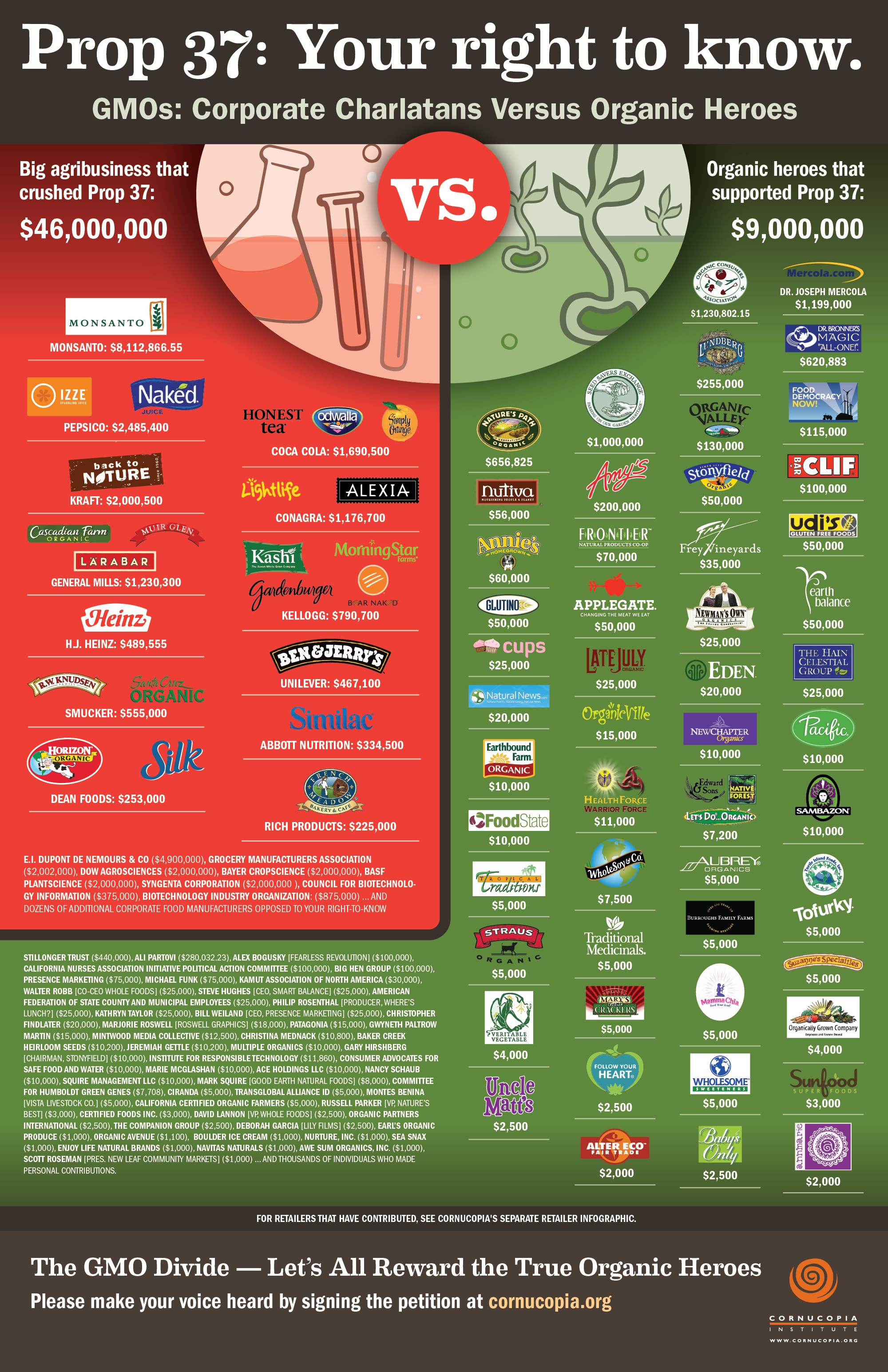
    You see, Dr. Mercola has taken a very public stance on a political initiative in this year’s elections – that is, he is in support of California Proposition 37, a proposition on the ballot in California on November 6 that would mandate labeling of foods containing Genetically Engineered (GE) ingredients.

    The opponents of Prop 37 have engaged in a vicious campaign to discredit Dr. Mercola and to sway public opinion. They accuse Mercola of having spent 1.1 million of his own dollars in support of Prop 37, as if it is somehow wrong for someone to be willing to support a proposition that simply calls for truth in labeling. What they conveniently fail to mention is that agribiz giant Monsanto has spent over $8 million to Mercola’s $1 million.

    And that’s just Monsanto!

    In fact, the “no” side, representing Big Agriculture, Big Food, and Big Biz in general has spent some 41 million dollars fighting the yes side’s $5 million – and the “Yes to Prop 37” side is still winning, according to the opinion polls!

    That’s right, Big Agribiz has outspent the people by 8 to 1, and they still are trailing in polls and are now resorting to smearing Dr. Mercola in online and print ads in their desperate attempt to stifle this truth in labeling proposition.

    Prop 37 isn’t about banning anything. If you like having GMO ingredients in your food you’ll still be able to buy them.

    That is your freedom of choice as an adult American.

    Prop 37 IS about making sure that you can know what is in your food so that you may make an informed choice.

    Dr. Myatt, Nurse Mark and the staff at The Wellness Club urge all California voters to please vote yes to Proposition 37.

    And we all stand firmly with Dr. Mercola in rejecting the lies and smear tactics of the Big Corporate Agribusiness funded “No on Prop 37” campaign.

    Please learn more about this at Dr. Mercola’s website: http://articles.mercola.com/sites/articles/archive/2012/10/31/dr-mercola-attacked-by-biotech-bullies.aspx?e_cid=20121031_DNL_art_1

    And at the Cornucopia Institute website: http://www.cornucopia.org/2012/08/prop37/

    And at the “Yes to Prop 37” website itself: http://www.carighttoknow.org/