Category: Opinion

  • Please Unsubscribe! Part II

    By Dr. Myatt and Nurse Mark


    In our last HealthBeat News Newsletter we told you to “unsubscribe” – WOW – did that get some attention!

    We actually had four people who took our “advice” unsubscribed – “duh, because you told me to...” But dozens of readers emailed to ask “what the heck?” and told us that they have no intention of unsubscribing as long as we keep on doing HealthBeat Newsletters. Thanks for your vote of confidence! We knew most of you would “get it.”

    So what are we really saying? We are trying to get across the idea that you should pick perhaps two to four of the most relevant health newsletters and drop the rest. Unless you are very careful in your interpretation of the dozens and even hundreds of competing newsletters and viewpoints out there, it is easy to become overwhelmed and confused with “information overload.” That, plus a lot of what is out in the world is unsupported and unproven bunk. We know because WE get these newsletters just to learn what kinds of information and pseudo-information is filling your inbox.

    It is easy to get swept up in the latest armchair theory or glowing report based on a mouse study, and because we know that you – our savvy HealthBeat News readers – are seeing these same pseudo-scientific studies and breathless reports, we need to be ready for your questions. To do that we read or review a number of both conventional and holistic medical journals and newsletters. Here are some, but not all, of the publications we follow:

    In conventional medicine, we monitor the following journals and websites daily:

    NOTE: Medscape, Practice Update and Pubmed each have multiple sub-specialties that we monitor, Including Oncology, Cardiology, Internal Medicine, Primary care, Diabetes Care, Senior Care and Fertility.

    In the field of holistic medicine, we subscribe to and monitor the following publications:

    So, do we recommend that you follow all these newsletters and websites as well?

    Heavens no! You would make yourself crazy! That’s what we were saying in our last HealthBeat News – pick the one, two or three of them, that are most relevant you and drop the rest. We review them all because we have to – it’s our job – and yes, sometimes we feel like it makes us a little crazy too.

    For example, should you read New England Journal of Medicine or JAMA every day? Probably not, unless you enjoy really dry, boring research articles. But we do, because this is the source that the lay press will misquote and build silly articles around.

    What about Medscape or Web MD? Maybe, but remember, these are conventional medicine – they are mainly geared to discussing things that can be addressed with prescription drugs or surgery. You won’t find much there that is alternative.

    We keep up with all the latest drugs and surgeries and conventional procedures. Why? Two big reasons. First, some of them are highly effective and should not be dismissed just because they are conventional. Second, since we offer alternatives, we need to know, alternative to what? Alternatives are most valuable when conventional medicine is ineffective. I would not try to steer someone away from a conventional treatment that is safe and effective. In fact, I need to be “in the know” because I prescribe such effective treatments!

    And what about the alternative newsletters and websites?

    Joe Mercola is one of the biggest and best known. Is Joe always right? We don’t think so, and we have taken him to task in the past over microwave ovens and magnesium stearate for example.

    In fact, as Joe has gotten bigger, it has become clear that he is no longer writing his own articles, and apparent to us that he may not be proof-reading them consistently before they are published – we have seen some glaring examples of strange science… But Joe has a good take on GMOs and vaccines to name just a couple…

    Who else is there? All the newsletters we follow are valuable to us, or we wouldn’t follow them. Does that mean they are all always right? Certainly not – but they each have their strengths.

    For example, if you want to know about cancer you might read Ralph Moss. For neurological and Parkinson’s information Marty Hinz is good. Life Extension Foundation is a great generalist, and their articles tend to be well-researched, but you’ll quickly notice that each and every new issue touts at least five new “breakthroughs.” Can there be that many new vitamins or herbs or combinations of vitamins and herbs “discovered” each month? No. LEF is just really good at finding new ways to market old products in new ways and new products before they are solidly proven.

    After you have been following all these many websites and authors for long enough you’ll notice that they each have their strong points and areas of expertise, and they often have some subjects or even pet peeves that would be better advised to leave alone since they tend to embarrass themselves with bad or non-existent science when they go there.

    You’ll also notice that a number are really just high-pressure sales sites in disguise – with breathless reports of “breakthroughs” that you just must have: “click here to order your supply today!” More on that later – to be commercial is not necessarily to be evil…

    Then there is a warning for those who might like to visit specialty association websites like the NEJM (New England Journal of Medicine) or maybe ASRM (the American Society of Reproductive Medicine) if your interest is fertility / infertility issues. These are great resources – as long as you have the scientific and medical background and knowledge to be able to correctly interpret the mountains of brain-numbing data available there. If you are a little weak on statistical analysis, organic chemistry, biochemistry, human anatomy and physiology, pathophysiology, genomics, neurology, or a dozen other specialized subjects, all you’ll do is make yourself crazy. You might even come away with some really wrong-headed, even dangerous ideas.

    Even Dr. Myatt and myself, with over 50 years in medicine between us, find ourselves going back to our textbooks and reference works as we try to absorb some of this information, to be sure that we are understanding it correctly. Dr. Myatt is known to pick up the phone and call the lead researcher on any medical article she has questions about.

    Our advice? Don’t try to read it all! Let us do that – it’s our day-job, and yes, sometimes it makes us a little crazy! But we’ll be sure to let you know when something important and valuable comes up – you can be sure you are getting the wheat and not the chaff. Pick a few favorites that are relevant to your interests, and enjoy – you will get more out of that than you will by trying to chase every shiny object that the internet offers.

    We hope you’ll continue to keep us on your short list! We spend many hours and do a lot of hard work and deep research to bring you our HealthBeat News articles, we use a highly reputable service to email your HealthBeat Newsletter to you, and maintain the server space and security services needed to house the Dr. Myatt’s Wellness Club website with its volumes of freely available information and the HealthBeatNews website with even more free information. But all that time and technology is not free – it has to be supported somehow – so yes, we hope that you’ll see fit to buy your vitamins and supplements from us in exchange for all the good information we bring to you.

    Yes we write articles telling you about the benefits of certain supplements, and yes, we sell them. Is that evil? We don’t think so – it keeps a roof over our heads and allows us to bring you these HealthBeat News articles.

    And yes again, you can probably go to your local health-food store or even a Big Box discount store and buy cheaper – sometimes ‘way cheaper – but please do be cautious and be sure you are getting the same top quality supplements that Dr. Myatt’s Wellness Club offers. Please review our article Wasting Money to Save Money? Who’s Watching Your Back? for more information about the false economy of ‘bargain brand’ supplements.
  • Please Unsubscribe to My Newsletter

    By Dr. Dana Myatt


    Thank you for being a subscriber to my HealthBeat newsletter. Nurse Mark and I spend a lot of time researching, writing and doing our darnedest to bring you quality medical news. I know many of you appreciate this because you write and tell us so.

    Here’s a problem I see in today’s information-overloaded world. TMI (Too Much Information) actually results in people taking less action. Less action = less results, including less health results.

    Why does this happen? Confusion.

    If you subscribe to dozens of health newsletters, you will surely encounter differing opinions. Possibly even totally opposite opinions.

    Then you can get so confused that you are paralyzed and do nothing, or do something in “dribs and drabs.” If you have elected to follow a truly helpful health behavior, a half-tailed approach will not be as effective (or may not be effective at all) as a sincere effort.

    But confusion can kill motivation.

    My Advice?

    UNSUBSCRIBE. That’s right. Choose the 3-4 holistic health newsletters that you believe to be of the highest quality, then unsubscribe to the rest. Pay good attention to the few newsletters and physicians that you follow.

    How Can You Evaluate the Quality of Health Information?

    It’s easy to sit back in a Barcalounger and pontificate about how the world works. Every real doctor knows “big words” (medical terminology) and can make even the preposterous sound plausible. Throw in some biochemistry terminology and, to paraphrase,  you can fool a lot of people most of the time. Unless you — yes, YOU — have in-depth understanding of human physiology, biochemistry and statistics (needed to help sort good studies from bad), be aware that it may be relatively easy to make something sound legitimate to you.

    There was a time my mechanic could pass off unneeded thinga-ma-jigetts and services to me because this isn’t my area of expertise.  Enter Nurse Mark, who was an auto mechanic when he was a Puppy. I haven’t been taken to the cleaners on unnecessary car repairs since I married him! But before that, I bought in to unnecessary “repairs” because it “sounded right.” But then again, I’m no car mechanic. I could be fooled.

    What Should You Do to End Confusion?

    Here’s my recommendation for choosing the 3 to 4 health newsletters (4 MAXIMUM) that you should follow.

    1.) Look at the Doctor’s  /  Writer’s credentials. I’ve seen newsletter authors who are “celebrities” and they have no credentials. They are “famous for being famous.” Maybe they’ve got a “medical degree” from the bogus-and-now-defunct Clayton’s School of Natural Therapy. That would be a mail-order medical degree. Seriously? Look for someone with some “bona fides.” Would you consult a lawyer or car mechanic with a mail-order degree?

    2.) Look for supporting evidence. If I say “the Earth is flat,” even with an eloquent argument, I should have studies, data, facts which support my claim. Many “holistic health newsletters” make big claims without ANY supporting evidence. Really? Does this seem right to you?

    3.) Check the References. If there is supporting evidence, medical studies, etc., check them out. You might not need to do this every time, but do it at first when you are deciding which newsletters to keep. Just because someone cites a reference doesn’t mean the reference is legit. I find that many “references” are non-existent, and you will, too, if you look.

    4.) The Best Authors Might be Folks Who Tick You Off Sometimes. If everything a person says is totally in alignment with your B.S. (Belief System), you will probably like reading their work. But that doesn’t prove their work has merit, only that they agree with you. Are you looking for the truth, or do you simply want your B.S. stroked?

    Someone who is reporting medical findings without prejudice and with references will sometimes annoy you, especially if they report something contrary to your already-existing B.S. That’s a good thing, because it means you may be opening yourself to a truth that you were blinded to before. There’s a reason for the expression, “The truth hurts.” Just remember that “the Truth shall make you free.”

    How We Research HealthBeat

    Nurse Mark and I  review over 24+ holistic newsletters. We also read the conventional medical news daily. In the next issue of HealthBeat, I’ll list who we read (both conventional and holistic) and who / what would be on my “short list” for newsletters if I were at liberty to have a short list. Right now, we see the good, the bad, and the ugly side-by-side. That’s why I can tell you that there is just some idiotic stuff you should ignore. I read it because some of you read it and I can anticipate the questions I will get as a result. But I encourage you to drop the unscientific, unsupported, un-credentialed stuff.

    That’s My Story and I’m Sticking To It.

    In Health,
    Dr. Myatt

  • But Consumer Lab says…

    By Nurse Mark


    Whenever we publish an article about supplements we invariably get questions and challenges to our statements and information.  We think that’s a good thing – it proves that our HealthBeat News readers are a sharp bunch.

    When it comes to vitamins and supplements there are a lot of opinions out there – everything from “vitamins are worthless; they’ll just give you expensive urine,” to “you can get everything you need from a healthy diet,” to “megadose vitamins will cure all illnesses.”

    We believe that the truth resides somewhere between these two extremes and that no, you cannot “get everything you need’ from a healthy diet – since it is almost impossible to find and follow a healthy diet these days, given the sorry state of our food supply, and given the stresses of our modern lives that deplete us of many essential nutrients more quickly than our ancestors were depleted.

    Most of our readers recognize that, too, which is why they are our readers – they are seeking solid, reliable information they can use to protect and improve their health.

    So it is both natural and good that our readers like to cross-check our information with other sources.

    One of the sources we hear about often is a company called "ConsumerLab.com", a company that holds itself out as an impartial judge of what is good and bad in the supplement industry. They promote themselves as being above reproach and beyond outside corporate influence because they accept no advertising. And impartial evaluation is good, right? Just like the “Consumer Reports” that they model themselves after, Consumer Lab says they derive income through the "subscriptions” and “reports" they sell to people like you and me.

    And they must be really good, right? After all, the mighty Dr. Oz has had them on his show, and that is a Really Big Deal.

    Let’s take a closer look at Comsumer Lab.

    First off, Consumer Lab is NOT a laboratory service. They do not do their own testing. They use outside labs for testing, and they won’t identify the labs they use and don’t tell us anything about their auditing of those labs for quality. Hmmm.

    How does  Consumer Lab decide what supplements to test? They contact dietary supplement makers and ask them to enroll in a “voluntary” testing program ­ for a fee.  We don’t know for sure how much as they won’t disclose their fees, but we heard of one company that was charged over $4,000 to test a single product. Companies that pay the fee are guaranteed that if one of their products passes the testing under their “Voluntary Certification Program,” they will be listed on the Consumer Labs website and may carry the “CL Seal of Approval.” If the product fails testing, the product will never be identified publicly because the results are “proprietary to the manufacturer”!

    On the other hand, companies that do not agree to pay risk having their products tested anyway through the CL “product review program.” If they “fail” the testing, negative results will be publicized on ConsumerLab.com’s website and in the media, with complete details for sale in CL’s Product Review Technical Reports.

    Doesn’t this sound a little bit like, “Pay up, and you won’t have to worry about the results, good or bad. Don’t pay up, and you might get some bad publicity…”?

    Does it remind you of “protection” rackets?

    Well then, what’s the point of all this? Is Consumer Labs bad? No, not necessarily. Do we mistrust them? No and yes. We take their “reports” with not one but two grains of salt. The point is that you need to be aware of what influences what you read and trust.

    You also need to be very careful when accepting editorial writings as fact. What is the research used to back up the article? Are there references offered for you to check? Do the references offered really substantiate the "facts" of the article? Do the studies quoted refer to clinical human studies, lab rat studies, Petri dish experiments, or armchair theorizing?

    We recently wrote about Vitamin D for prostate and other cancers. That prompted one of our readers to send us this question:

    “Consumer Lab calls blood levels of 20 ng/ml vit. D sufficient, 25-35 perhaps beneficial, but then says to NOT go over 39 ng/ml…?”

    Dr. Myatt was familiar with the CL article about Vitamin D and replied:

    Double Check Everything, Trust Nobody… Not Even Me…
    The CR article and cited study didn’t say over 39 was problematic, it said in one study they didn’t find benefit. But there are numerous studies that we cite in our Vit D paper that show positive benefit from the levels I put forth as optimal. We always provide the medical references so you can do your own due diligence.
    I stand by my recommendations.

    The moral of this story? Always check the references yourself – and be sure that you understand exactly what those references are saying. Even more important, make sure you know and trust WHO is saying them.

  • The Straight Scoop On Quality – In Articles, Supplements, And Medical Care.

    By Nurse Mark


    This week I’m going to address a couple of customer / patient comments, and some thoughts that those comments bring to mind.

    While these may be somewhat different issues, they are also related – so bear with me.

    First there was a nasty-gram that accompanied an "unsubscribe" order from last week’s HealthBeat News report on citicoline.

    The writer, from Australia no less, bashed us as being "ugly Americans" for insulting her by discussing in depth a supplement that we also happen to sell. This is not the first time we’ve been taken to task for writing about something that we also sell – I guess the thought that we might make a nickel of profit from by selling a health-giving substance just really upsets some people.

    She then went on to tell us that we had offended her by writing too extensively about citicoline – that we had "talked down" to her somehow by discussing it’s uses and benefits in a lengthy, fully-referenced article. She told us that if we couldn’t "sell" her on something within the first paragraph, then anything more than that simply insulted her.

    Ouch!

    Now I know that recent research  has shown that the average attention span of an American has now reached an astounding low of 8 seconds – fully one second less than a goldfish – but really, I believed better of our Healthbeat News readers which is why we offer you in-depth, fully researched articles and not just flashy sales "puff-pieces."

    Next there were some questions from someone who is considering taking one of the infrequently available spots in Dr. Myatt’s concierge medical practice. As most of our readers know, Dr. Myatt has for a number of years been limiting her practice to around a dozen or so patients at any given time. Most of her private practice patients stay under her intensive care for 6 months to a year or even longer, but when they achieve their health goals and "graduate" to less intensive needs Dr. Myatt can offer an opportunity to work with her to someone new. This is a big, life-changing commitment for most people and it is not unusual for folks to have questions.

    Here are a few of these recent questions, and my answers to them:

    Question: what are your payment plans?

    Many of Dr. Myatt’s patients prefer to make a single payment. Having said that, others may pay quarterly, or monthly, or in some other arrangement.

    Question: Are you able to prescribe medication through a traditional pharmacy?

    Yes, Dr. Myatt is an NMD – a Naturopathic Medical Doctor – and has all the privileges of any other Medical Doctor. That is, she has a DEA number and can prescribe allopathic patent medicines including scheduled (narcotic) drugs if necessary, she can order lab tests and other diagnostic procedures, and even commit surgery. She is in a better position because of her expanded knowledge, skill, and experience to prescribe thyroid and hormone (especially natural thyroid and  bio-identical hormone) therapy than most “conventional” or allopathic doctors. (This patient was especially interested in Dr. Myatt’s thyroid and hormone programs.)

    Question: how long have you been doing concierge medicine?

    Dr. Myatt began sharply limiting her practice about a decade ago and found that it allowed her to provide much better care and obtain better patient outcomes, so she has continued to do so and has found that around a dozen intensive patients at any one time is a perfect number.

    Question: And is any of this billable to insurance?

    Every insurance plan allows for different services to be billed. Many plans allow “discretionary” spending by the insured for non-allopathic medical expenses as do most “Medical Savings Plans.” You would need to enquire of your insurance plan for answers to these questions.

    We do not participate in any insurance plans as we have found that 1.) most insurance plans are interested in covering allopathic medical treatment only, and , 2.) the amount of time and bureaucratic paperwork involved in satisfying insurance billing requirements requires a doctor to rely on a production line – like practice model that does not encourage the kind of intensive and individualized care that Dr. Myatt wishes to provide.

    Dr. Myatt recognizes that medical care is expensive and she will insist that you also maintain a relationship with an allopathic “insurance doctor” so that if / when Dr. Myatt recommends something that can be covered by your insurance plan (diagnostics, tests, prescriptions, etc.) your “insurance doc” can be called upon to order these things for you.

    Question: Are the supplements you suggest purchase through your wellness club or are they something I get on my own?

    We have a broad range of supplements available through The Wellness Club.

    Dr. Myatt began the supplement side of The Wellness Club many years ago when she found that often her patients were not getting the results she wanted from her recommendations. It became apparent that many were using sub-standard supplements in terms of potency and purity and because of this the suggested supplements were not effective.

    She began supplying carefully selected supplements to address this problem and immediately noted improved patient outcomes.
    She formulates many of her own supplements, and all of the items she offers are subject to an extremely rigorous Quality Control audit. She is known amongst suppliers and manufacturers (behind her back, they believe) as “The Dragon Lady” because of her unwillingness to compromise on quality.

    As always, Dr. Myatt’s patients (and you, our HealthBeat readers) are welcome to obtain supplements anywhere. We offer a variety of supplements that we have vetted for quality and purity, but we also recognize that you might find something similar at Billy-Bob’s Big Box Bargain Basement And Warehouse Outlet at a lower cost. But please be careful – Did Billy-Bob do an extensive Quality Control Audit on those vitamins like Dr. Myatt, or did he get a really great deal on cargo salvaged from the truck that overturned on the interstate last year and sat in a hot warehouse waiting to be released by the insurance company?

    Don’t laugh, it happens!

    We have written about quality in the supplement industry before: Wasting Money to Save Money? Who’s Watching Your Back?

    We reference the importance of quality often in our articles because it is so important to your health and your pocketbook both. Here is what Dr. Myatt had to say in a recent article "7 mistakes people make when taking supplements"

    "I’ve said this so many times that I feel like a broken record, but still a lot of folks just don’t get it. So I’ll keep saying it.
    The nutritional supplement industry is the Wild West for quality. Although things are improving, it is still a jungle out there. More expensive isn’t always better but also be careful of products that are "bargain basement." Our saying at The Wellness Club is "the most expensive supplement is the one that doesn’t work." If you paid $1.99 for two months’ worth of pixie dust, and it doesn’t do anything for you, then you haven’t saved a bunch of money. You’ve wasted $1.99. "

    So, there you have it – a purely informative HealthBeat News article. No products were offered for sale in the making of this article. Hopefully no feelings were offended.

    But – stay tuned, because we are planning to offer you money for giving us a piece of your mind. Here’s the plan: Since we want to give you, our readers what you want and you know what you want better than we do, we are going to be doing a survey very soon to ask you just exactly what you want from us in HealthBeat News.

    We’ll give you an opportunity to tell us what you want, what you don’t want, and how you want it. And we’re going to pay you for your time. How fair is that?
    Watch for it… coming soon.


    http://www.statisticbrain.com/attention-span-statistics

    http://healthbeatnews.com/wasting-money-to-save-money-whos-watching-your-back/

    http://healthbeatnews.com/?s=bargain

  • Where Are The “Cures” From Medical Science?

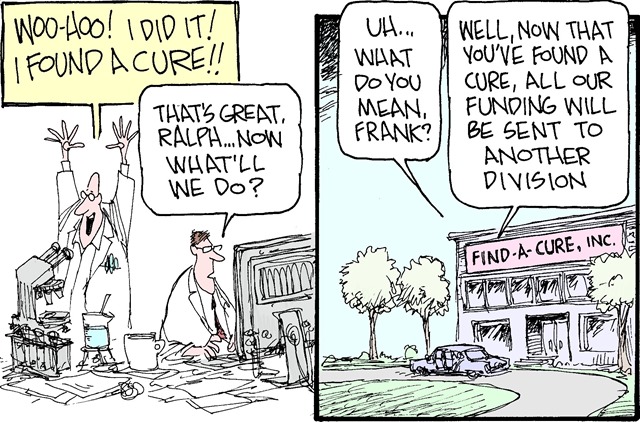
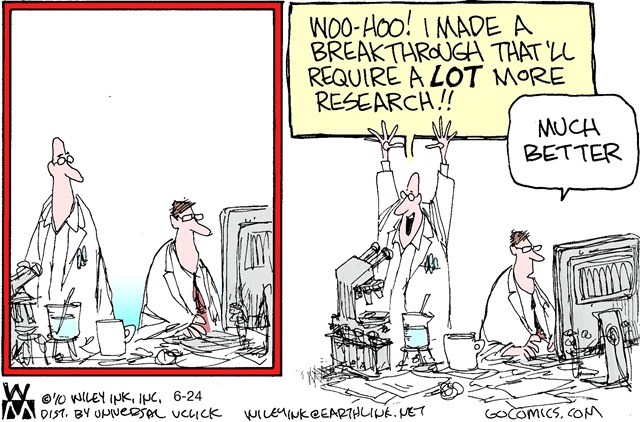
    So, with all the money that Big Pharma pours into research, supposedly to find “cures” for the ills of mankind, where are those cures? Why do we still battle cancer and heart disease and Alzheimer’s disease and countless other ailments?

    There are plenty of “conspiracy theories” out there: but here is a look at the issue that we think contains more than just a grain of truth. One of my favorite cartoonists sums up the state of medical research quite nicely:


    WileyCure1WileyCure2


    NON SEQUITUR © 2014 Wiley Ink, Inc.. Dist. By UNIVERSAL UCLICK. Reprinted with
    permission. All rights reserved.