Author: Wellness Club

  • Statin Drugs: The Evil Of A 20 Billion Dollar Industry

    By Nurse Mark


    Follow The Money

    StatinWarning


    If you ever want to know how or why something bad happens, just follow the money.

    Anything that is worth 20 billion dollars a year is sure to have players involved that are careful in safeguarding their interests. Silly, inconsequential things like “the public good” have no place in such industries.

    The money is everything.

    And so it’s no surprise that research critical of something as profitable as statin drugs rarely ever sees the light of day.

    Researchers that dare to challenge the statin industry often find that their next research project is more along the lines of personally discovering the joys of flipping burgers on the late shift. You can be sure that there will never be grant money again for such rebels

    We have written before about the dangers of statin drugs and the near-religious fervor with which statin proponents in Big Pharma and Big Medicine (which are really one in the same) protect this cash-cow drug.

    Buried Research


    Here is a research paper that we are betting you’ll never hear about anywhere else.

    Two researchers in Ireland mined the conventional medical literature sources of Pubmed, EMBASE and the Cochrane review databases for articles about cardiovascular care and statin side effects. What they found was not pretty.

    Their paper, titled “The Ugly Side of Statins. Systemic Appraisal of the Contemporary Un-Known Unknowns” concludes (in part):

    These finding on statin major adverse effects had been under-reported and the way in which they withheld from the public, and even concealed, is a scientific farce.

    Ouch!

    Some Of Their Findings:

    For every 10,000 people taking a statin, there were:

    • 307 more patients with cataracts
    • 23 additional patients with acute kidney failure
    • 74 extra patients with liver dysfunction


    Playing the percentages:

    • statin therapy increased muscle fatigue by 30%
    • statin therapy at higher doses resulted in rhabdomyelosis in 11.3% of users


    Be Afraid Young Man!


    Nothing strikes fear into the heart of a young man (or a man at any age) more than erectile dysfunction, which was found to be 10 times more likely to occur in young men taking even the lowest dose of statin drugs.

    The ray of sunshine? When statins were stopped over 50 percent had full recovery within 6 months.

    The others? Good question…

    It’s A Choke


    While searching through the FDA Adverse Event Reporting System database the researchers found that for every 10,000 reports of a statin-associated adverse event, approximately 40 reports were for statin-induced interstitial lung disease – a condition that can lead to devastating, even deadly, Pulmonary Fibrosis.

    This Is Not So Sweet


    The U.S. Veterans Affairs healthcare system is as “conventional” as they come. Still, a V.A. study on 15 million veterans in 10 hospitals in the southern US found that statins affect fasting and postprandial (after eating) glucose levels by causing hyperglycaemia (high blood sugar) in diabetic as well as non-diabetic patients.

    Another major study showed a significantly increased risk of developing hemoglobin A1c readings of greater than 6% in both diabetics and non diabetics.

    Other researchers have demonstrated that statin drug therapy can cause insulin resistance.

    Women, Heed This


    Another highly-regarded study, the JUPITER study, showed that statin therapy can cause full blown type 2 diabetes in women.

    A recent study from the Womens Inititative looked at 153 840 post-menopausal women without diabetes. Following these women over a number of years found that 10,242 developed diabetes.

    Statin use was associated with an increased risk of diabetes and this association remained after adjusting the data for other potential causes and it was seen with all types of statin medications.

    Senior Moments


    Researchers found that prescribing a statin to seniors increases their risk of developing diabetes by 9%.

    A Shaky Relationship


    Parkinson’s disease strikes fear into the hearts of seniors.

    A strong association between lower cholesterol levels and increased risk of Parkinson’s disease has been reported. Researchers found that each mmol/L increase in total cholesterol was accompanied by a 23% decrease in the risk of developing Parkinson’s disease.

    Interestingly, the risk reduction was significant in women but not in men.

    Statins And Cancer?


    One review found that statin therapy increased risk of non-melanoma skin cancers. Another researcher reported that long term statin use was associated with an increased risk of colorectal cancer, bladder cancer and lung cancer.

    Other evidence shows an association between the use of statin in patients after kidney transplant and increased risk of developing of squamous cell carcinoma.

    The researchers state that “For unknown reasons, since these publications the squamous cell carcinoma [information] has been excluded in all reports from subsequent statin trials. Hmmm…

    I See Problems Here…

    Cataracts are becoming increasingly common, and people are developing them at younger ages. Why?

    Research has found that statin drug users have a 50% probability of developing cataracts at an earlier age than non-statin users, who tend to develop them at a significantly later age.

    But This Takes The Prize!


    Statin drugs, given to us by Big Pharma with promises of preventing cardiovascular disease, actually have been found to increase the prevalence and the extent of coronary plaque calcification – a major component of cardiovascular disease.

    That’s right, a review of research data showed a strong association between statin use and the progression of coronary artery plaque. Oops…

    What’s more, The Veteran Affairs Diabetes Trial found that statin use was linked to accelerated progression of Coronary Artery Calcification (CAC) in participants with Type 2 Diabetes without previous coronary artery disease, despite the fact that the statin users had significantly lower and nearly optimal LDL-cholesterol levels.

    Could It Get Any Worse For Statins? Yes, Yes It Could.


    Statin drugs activate the Atrogen-1 gene which causes muscle atrophy, wasting and damage.

    The heart is a muscle – perhaps the most important muscle in your body!

    Statin induced cardiomyopathy (damage to the heart muscle) is the result of statin-induced coenzyme q10 deficiency and statin-induced Atrogen-1 activation.

    The Bottom Line?

    Cholesterol is crucial for energy, immunity, fat metabolism, leptin (the hunger/satiety hormone), thyroid hormone activity, liver health, stress tolerance, adrenal function, sex hormone synthesis and brain function.

    Do we really think it wise to tamper with our body’s own regulatory mechanisms in order to force our cholesterol levels to conform to some artificial standard?

    Perhaps we might be better served to address the causes for our epidemic of “metabolic syndrome” and “high cholesterol levels” that seem to have come along with it.

    Poor diet, lack of exercise, stress, toxins, all these things affect our finely balanced human system – what we medics call “homeostasis.”

    To learn more about how to help your body support healthy cholesterol levels, please visit our webpages discussing Self-Help for High Cholesterol here and here and be sure to read our previous HealthBeat News articles on both statin drugs and cholesterol.

    Learn more about the vital substance cholesterol in The Truth About Cholesterol Pt.I and The Truth About Cholesterol Pt.II

    Finally, has your conventional doctor used the words “ticking time-bomb” or something similar in trying to get you to accept a a prescription for a statin drug? Yes? Run, don’t walk, away from it! And contact Dr. Myatt for a Brief Telephone Conversation to learn what your options really are.


    Reference:

    This article is a synopsis for lay readers of an original research paper. The original paper is fully referenced and is available for review by interested readers:

    Sherif Sultan, Niamh Hynes: The Ugly Side of Statins. Systemic Appraisal of the Contemporary Un-Known Unknowns.
    Open Journal of Endocrine and Metabolic Diseases, Vol. 3  No. 3 (2013) , Article ID: 34065 , DOI:10.4236/ojemd.2013.33025
  • Vitamin Supplement "Facts" That The Media Got Wrong

    By Dr. Dana Myatt


    There’s a reason that the “mainstream media” has earned a more accurate name “the lamestream media.” Actual journalism is a lost art – most “reporters” now craft their stories to satisfy an agenda – either theirs or their employers. Here are a few examples:

    1.) What the Headline said: "Vitamin Pills a Waste of Money"

    What the research actually said:

    To quote the article directly: “Two large trials [with 27,658 individuals] reported lower cancer incidence in men taking a multivitamin for more than 10 years. High quality studies were scant…" (meaning: not enough data to draw good conclusions about the rest). (1)

    Dr. Myatt’s comment: It should be noted that the "multivitamins" examined in the study were low-potency ("one a day") supplements, something that has never been proven to be of much benefit to anyone except those severely deficient.

    2.) What the Headline said: "Multivitamins of no benefit to seniors."

    What the research actually said:

    To quote the article directly: "Multivitamins and mineral supplements were found to reduce the mean annual number of days spent with infection (three studies) by 17.5." (2)

    Dr. Myatt’s comment: Again, the "multivitamins" examined in the study were low-potency ("one a day") supplements, something that has never been proven to be of much benefit to anyone except those severely deficient. But even at low potency, there was a decreased risk of infection in the elderly.

    3.) What the Headline said: "Vitamins are linked to increased risk of death."

    What the research actually said:

    The study (if you can call it that) — asking folks to report from memory what supplements they had taken years previously — actually found the following:

    • B complex vitamins were associated with a 7% reduction in mortality
    • Vitamin C intake associated with a 4% reduction in mortality
    • Vitamin D intake associated with an 8% reduction in mortality
    • Magnesium intake associated with a 3% reduction in mortality
    • Selenium intake associated with a 3% reduction in mortality
    • Zinc intake associated with a 3% reduction in mortality

    Dr. Myatt’s comment: This study was so poorly done, and the "findings" so misreported, that I wrote an entire article about it here: Vitamins Linked to Increased Risk of Death ?

    Now for the Positive Studies Your May Not Have Seen


    1.) Multivitamins Decrease Women’s Heart Disease Death.

    According to the National Institutes of Health (NIH), the "multivitamins don’t help" argument is far from over. Women who took multivitamin-mineral supplements for three years or more were significantly less likely to die from heart disease. (3)

    2.) Multivitamin users have lower risk of dying from stroke.

    To quote the article directly: "Conclusions— Multivitamin use, particularly frequent use, was associated with reduced risk of total and ischemic stroke mortality among Japanese people with lower intake of fruits and vegetables." (4)

    The number of studies showing positive benefit in multivitamin use are so overwhelming that we have written about them numerous times. Please see the following articles with multiple references.

    A Dozen Proven Reasons to Take a Good Multiple:

    Give Me One Good Reason to Take a Multiple


    Dr Myatt’s Bottom Line and Summary

    1. The preponderance of evidence is far in favor of taking a multiple vitamin/mineral supplement for health.
    2. "One a day" multiples are of limited value in improving health. Please see "Maxi Multi" for a discussion of optimal potency multiple vitamin formulas.
    3. Regular users have far more benefit than casual users. Take your multiple every day.


    References:

    1. Fortmann SP, Burda BU, Senger CA, Lin JS, Whitlock EP. Vitamin and mineral supplements in the primary prevention of cardiovascular disease and cancer: an updated systematic evidence review for the US Preventive Services Task Force. Ann Intern Med. 2013 Dec 17;159(12):824-34.

    2. El-Kadiki A, Sutton AJ. Role of multivitamins and mineral supplements in preventing infections in elderly people: systematic review and meta-analysis of randomised controlled trials.BMJ. 2005 Apr 16;330(7496):871

    3. Bailey RL, Fakhouri TH, Park Y, et al. Multivitamin-mineral use is associated with reduced risk of cardiovascular disease mortality among women in the United States. J Nutr. 2015 Mar;145(3):572-8.

    4. Shigeki Yamada, MD; Akio Koizumi, MD; Hiroyasu Iso, MD; Yasuhiko Wada, MD, et al. Risk Factors for Fatal Subarachnoid Hemorrhage: The Japan Collaborative Cohort Study.

  • True ICD-10 Codes

    By Dr. Dana Myatt


    Conventional doctors must follow really strict rules to bill insurance. A massive book called the ICD (International Statistical Classification of Diseases and Related Health Problems) is now on volume 10 – hence it’s new name, the ICD-10. The ICD book has a number for everything imaginable because without an ICD number an insurance claim cannot be submitted or paid.

    Just looking up codes and filling out insurance forms is highly paid specialty work – which is part of what makes conventional medicine so obscenely expensive.

    Here are some additional actual billing codes for insurance, taken from the new ICD-10 code book – this is what makes being a physician more fun than a barrel of moneys.

    V91.07XA  Burn due to water-skis on fire, initial encounter.
    (Stunt gone wrong? Water skiing too fast?)

    V97.33XD Sucked into jet engine, subsequent encounter
    (Let’s see…. you got sucked into a jet engine once and lived, then let it happen again? As John Wayne said, "Life is hard. It’s even harder when you’re stupid.")

    E012.0  Activities involving knitting or crocheting.
    (I always advise my patients to avoid high-risk sports)

    W61.61XA Bitten by duck, initial encounter.
    (I have a duck. Ducks do not have teeth.)

    W61.61XD Bitten by duck, subsequent encounter.
    (This happened twice? Did I mention that ducks do not have teeth?)

    V61.6XXD Passenger in heavy transport vehicle injured in collision with pedal cycle in traffic accident, subsequent encounter.
    (Help me here. Someone in a heavy transport vehicle was injured hitting a bicycle? Twice? What are the chances???)

    R46.1 Bizarre personal appearance.
    (This code created especially for Lady Gaga)

    Y92.253 Hurt at the opera.
    (I know, I’ve been to some seriously awful performances myself)

    W22.02XA Walked into lamppost, initial encounter.
    (Drunk, or texting?)

    W22.02XD Walked into lamppost, subsequent encounter.
    (Some people never learn)

    V95.45 Spacecraft explosion injuring occupant.
    (Does anyone actually survive this?)

    W27.4XXD  Contact with kitchen utensil, subsequent encounter.
    (I suspect fowl play…maybe involving that biting duck)

    S10.87 Superficial bite of other specified part of neck, initial encounter.
    (Yep, Vampires are real, folks)

    and my personal favorite…

    T81.10  Therapeutic misadventure
    (a.k.a. "Ooops," and also known as “the doctor screwed up,” also known as a malpractice lawsuit)

  • My $123 Hip Replacement

    By Dr. Dana Myatt


    I’m a better doctor now — and much more sympathetic — since I started having hip pain in March of 2014.

    It started subtly at first, a little stitch in my right hip that I noticed after my morning walk. "Probably just more walking than I’m used to," I’d tell myself.

    arthritic_hip_th Over the next several months, the pain became much worse. Sometimes it was in my hip, other times my low back. Sometimes it was both. Sometimes it would radiate to my knee and even my ankle and foot.
    At first, my beloved bromelain would help. When that stopped working, I tried my favorite NSAID, ibuprofen. Same thing — a little help, then nothing.

    By now, the pain was getting severe. Instead of dogging me only after walks, it would wake me up in the middle of the night. No amount of  changing positions seemed to help. The ache was deep and gnawing and interfered with my sleep.

    I used my IRest “TENS” unit, did back and hip exercises and stretching, took all the right supplements, thought good thoughts. Nothing seemed to make much difference.

    Deciding it was time to get help, I saw a naturopath who is one of the best spinal manipulators (kind of like chiropractic) I know. All naturpoaths are trained in spinal and visceral manipulation by the way.

    He manipulated me two times a week for a few weeks and sent me home with back exercises (which I had already started on my own). I did them. His manipulations and exercises helped a little, but not for very long. The nightime deep ache continued. Driving my car became torture.

    "Dr Nick" suggested I get a back and hip x-ray, which I agreed to. One of the signs of bone cancer or cancer that has metastasized to bone is a deep, unrelenting ache. I won’t say I feared for the worst (it’s not my style), but the pain had become so constant and relentless that the thought crossed my mind. So I wrote myself lab orders and had x-rays taken.

    The results were good news and bad news. The good news? No evidence of bone disease like cancer or osteoporosis. My hip joints were fine. I have a slight anatomical "difference" from side-to-side, but this is so common that it’s the rule, not the exception. Nothing Big Bad wrong to explain my pain, and that was good. But nothing seen to help me know how to cure it, and that was disappointing. Still, I was relieved that this brutal pain wasn’t a cancer – which can also gnaw deeply. "No news was good news," sort of.

    I all but stopped my daily walks since they only aggravated the condition. I found myself hobbling like some old people that I feel sorry for.

    Nurse Mark is a Genius

    I was lamenting my condition to Nurse Mark who has has worked everything from the emergency ward to hospice, with orthopedics in between. It was his orthopedic experience and his insistent genius that saved me.

    Nurse Mark told me the story of when he admitted a little old lady who was scheduled to have first one, and then probably the other hip replaced. Mrs. Rossi (we’ll call her that) had been very active, walking everywhere: To the store for each day’s groceries, to attend Mass, to visit friends and family. That was "had been," because for the past year she had been crippled with hip pain that nothing — not drugs, not physiotherapy, not massage — had helped. This once active and independent lady was now barely able to shuffle using a walker for support. New hips seemed the only solution.

    As Nurse Mark did her pre-operative assessment he noticed the shoes that Mrs. Rossi was wearing. He asked her if she was wearing those same shoes when she had seen her orthopedic surgeon, or when she had gone to her physiotherapy appointments. No she replied, looking at him as if he had two heads. Of course she would “dress up” to visit the physiotherapist and especially the doctor – these were her “everyday” shoes, not her “good” shoes.

    Nurse Mark called the orthopedic surgeon (we’ll call him “Dr. Frank”) to discuss Mrs. Rossi’s admitting orders. He artfully asked if Dr. Frank had ever seen Mrs. Rossi in her “everyday” shoes?

    Dr. Frank blustered that Mrs. Rossi’s shoes always looked fine to him, and “so what of it?” Nurse Mark explained that he was afraid if Mrs. Rossi were to walk on her “everyday” shoes post-operatively, she might undo all the fine work that Dr. Frank was about to put into her new hip.

    Dr. Frank sputtered and grumbled, but that evening when he made pre-operative rounds he ordered Mrs. Rossi to put on her walking shoes and walk for him. Nurse Mark says his face went pale. He ordered her surgery delayed and he asked her family bring in her “good” shoes. When he saw her walk in her “good” shoes, he demanded that she throw away the “everyday” shoes. The old woman complained that “they look fine – lots of wear left!” but the Dr. insisted and ordered the physiotherapist to fit her with a new pair of “everyday” walking shoes. That did the trick and she never did come back for “new hips.”

    As I listened to the story, I realized that I had increased my walking since taking up part-time residence in Phoenix. Most mornings I’d walk 3-4 miles on uneven desert ground. Still, my running/walking shoes looked fine. Good for another year at least.

    At Nurse Mark’s insistence (I was an easy sell at this point because I was desperate), I went to a local running store that does "gait analysis." They filmed the back of my feet as I walked on a treadmill, then showed me the pictures.

    Although my shoes look quite good by "eyeball," I was clearly lop-sided from the back while walking. Close inspection of my shoes (and it did take CLOSE inspection), showed an uneven wear pattern on the heels.

    I tried on about twelve pairs of shoes. They had me walk in each to see which felt the best. I finally found one pair that felt good on my feet and almost immediately, my hip felt better. I hoped against hope it wasn’t just a placebo effect that would wear off.

    Five Months Later…

    After nine months of suffering, I have been pain-free for five months. I still walk; in fact I’m "back in the saddle" with daily walks or bike rides. No pain. No limp. Nada.

    Those shoes cost me $123 which, for a simple pair of walkers, seemed a choke at first. In retrospect, it was one of the biggest health bargains of my life.

    Two Reports from the Field

    Yo, Joe! A friend of ours was limping when we saw his last month. He is obese, and said he "knew" his weight was the reason for his hip pain. It’s true that carrying excess weight puts a strain on joints, but we took a look at his shoes and advised him to get new ones. He did. I talked to him last week: his pain is gone and he no longer limps. Shoes: $158. Being pain-free: priceless.

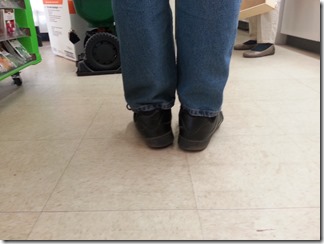
    Stranger in the hardware store. I wanted a picture of a far-advanced example of shoe-wear to show you, but such pics are hard to come by on the internet. Make that "impossible" to come by. Had I known that replacing my own shoes would work miracles, I would have saved the old ones for a photo. Alas, I decided to toss them right away because, as Nurse Mark rightly pointed out, if I kept them I would probably wear them again as "beaters." So out they went.

    Bad ShoesOne day entering the hardware store I saw a man with a great example of a far-advanced case of shoe wear – he was literally falling off the sides of his shoes. I wanted a photo but didn’t quite know how to ask. (I’m so shy). The man cut in front of me for help, then apologized. I said I’d forgive him if I could have a picture of the back of his shoes. He looked befuddled but agreed. When he asked why we wanted them I showed him the pictures and explained about the back/hip pain.

    "Oh my Gosh!" he exclaimed. He bent over and pulled his pants down to show me his lower back. (It’s OK, I’m a doctor). He had a long scar from the older style of low back surgery. I recognized it immediately.

    "But," he explained, "I’m still in a lot of pain. I take pain-killers every day."

    "I’d get a new pair of shoes," I recommended with full confidence.

    "I have a new pair already, and now that I think of it, my back does feel better when I wear them. I just don’t wear them very often because they’re new and they were expensive and I was saving them for special occasions. And besides, these shoes look just fine from the top! I’m going to go home and throw these away and start wearing the new ones. Thank you so much. This was my lucky day to meet you like this!"

    I haven’t heard from the fellow but I have a high confidence level that he is feeling much better. Now I’m left to wonder: how many people have gotten hip or knee replacement surgery when what they really needed was a pair of new shoes?

  • Dr. Myatt Talks About Hormones

    By Nurse Mark


    Hormones: Essential, important, complicated, confusing. Everybody’s got them, but not necessarily in the right amounts – our hormone levels are a very delicate balance. They tend to decline and become unbalanced as we age, though it doesn’t have to be so.

    It seems everyone wants to know more about hormones: how to keep them healthy, how to correct imbalances, how to replace hormones lost to age.

    We were at an event a few weeks ago and as always the subject of conversation turned to health, and because Dr. Myatt was chatting with several women, the subject quickly turned to hormones and health. (as I was sitting there I noticed a lot of men listening in on the conversation too!)

    Keeping a promise to send further information to one gal who was especially interested, Dr. Myatt sent the following email. See if it doesn’t help you understand hormones a little better too:

    Thoughts on Hormones
    You were interested in "hormones," but this is a broad term (all puns intended) and if I know specifically what your questions are, I can do a better  job of answering them. But I’ll make a guess just in case.

    Many people feel that maintaining hormone balance AND a bit higher levels of hormones as we age may have a longevity and health benefit. There is substantial research to validate this opinion and I for one use and recommend supplemental hormones. So did conventional medicine for several decades until the The Women’s Health Study showed higher rates of breast cancer among hormone users. So many women stopped taking them.

    Ah, but here’s "the rest of the story." (Since many of us know that Lame-stream media doesn’t do a good job of anything akin to actual journalism any more).

    Estradiol, the most potent female estrogen AND the one prescribed in conventional medicine is not associated with an increased risk of breast cancer. However, when used alone, it is associated with an increase of uterine cancer. This is called "unopposed estrogen" and it is not how the female body produces hormones so it is little surprise that this use of a single hormone causes problems.

    So in the Women’s Health Initiative Study, a progestin (synthetic progesterone) was added to estrogen. The combination cause a significant increase (24%) in breast cancer and more aggressive forms of breast cancer. This was reported as "estrogen causes breast cancer," a far cry from what the data showed. What actually raised breast cancer rates was the addition of a non-bioidentical progestin, a molecule that does not duplicate the progesterone a woman’s body naturally makes.

    On the "natural side," no large studies like the Women’s Health Initiative have been done to confirm the safety and effectiveness of bio-identical hormone replacement although there is data to suggest that it is a whole different ball game. But if you’ve read Suzanne Sommer’s book or similar, the benefits might be over-stated.

    DHEA, a sex-hormone precursor made by the adrenal glands, has quite a bit of study which shows that declining levels with age are associated with declining memory, strength, immune response and more. Progesterone is usually the first female hormone to decline at menopause and those lower levels are associated with diminished bone strength,  insomnia, hair loss, mood swings. The natural "bio-identical" form of progesterone has never been shown to cause problems like synthetic progestins cause. And sometimes estradiol or the weaker estrogen, estriol, can help with hot flashes and other menopausal symptoms.

    I always perform a hormone test before initiating hormone treatment. Why would anyone want to shoot in the dark if they can turn on the light?

    Now that I’ve expounded on hormones, what specifically are you wanting to know about? This is a favorite interest of mine because
    I believe good hormone balance is important to overall health. Do you have any specific symptoms and you are wondering if hormones
    might safely help?

    Wow – there you have it: woman to woman advice and information about female hormone replacement.

    Fellas, did you know that Dr. Myatt is also expert in sorting out male hormones too? There is just as much mis-information and fear-mongering surrounding male hormone replacement as there is surrounding women’s hormone replacement.

    Why trust your hormone health to a conventional doctor handing out conventional cookie-cutter prescriptions for one-size-fits-all synthetic drugs when there are experts like Dr. Myatt available to help you find your perfect hormone balance and subsequent best health?

    Dr. Myatt is available very inexpensively for Brief Telephone Consultations and can design a Bio-Identical Hormone Program specifically for you.

    Learn More about Dr. Myatt’s Brief Consultation process here: https://www.drmyattswellnessclub.com/BriefConsults.htm

    And learn more about bio-identical hormone replacement and Dr. Myatt’s Bio-Identical Hormone Programs here: https://www.drmyattswellnessclub.com/BioIdentical_Hormone_Program.htm