Author: Wellness Club

  • When "Sorry" Doesn’t Help

    How many of your New Years resolutions have you managed to keep?


    Any of them?


    Yeah, I didn’t think so… and it’s not even the end of January yet!


    You promised yourself you would walk the dog, faithfully, come rain or shine…

    Then came that snowy, blustery day.

    You promised yourself no more sugary treats…

    Then someone brought in a plate of fudge to the office.

    You promised yourself you would get in shape this year…

    Just as soon as that gee-whiz exercise treadmill comes on sale – maybe next week.

    “Sorry” you say to your pooch, as you put him out the back door into the weather…

    “Sorry” you say to your doctor when the blood test shows you one step closer to diabetes…

    “Sorry” you say… “I’ll do better – I’ll try harder… next time…”


    When “Sorry” Doesn’t Help


    By Dr. Dana Myatt


    When I was a child, I would occasionally do something I wasn’t supposed to. (“Oh, no, NOT Dr. Myatt!” I can hear you thinking 🙂 ) Sometimes when I would apologize, my dad would say “Sorry doesn’t help.” Like the time I deliberately dropped one of my mom’s antique bowls on the lawn to see if it would break (I didn’t think it would). It did. I was confused when dad would say “Sorry doesn’t help,” because I thought that “sorry” was ALWAYS the “cure” for wrongdoing. Now that I’m older (O.K., MUCH older), I understand what he meant.

    For all the apologies and “true confessions” I hear in practice, you’d think I was a priest instead of a doctor.

    • ” Oh, Doctor Myatt, I just HAD to eat that food over the holidays. My parents (or children, friends, great-aunt Millie) would have been SO disappointed if I didn’t eat that special cake they baked.” (Yeah, right, like they don’t know you’re a type I diabetic with a kidney transplant).
    • ” I felt sorry for myself so I’ve been eating the wrong foods. Don’t get mad at me.” (I’m not mad— not even angry— with you. Sick people keep me in business).
    • ” I just can’t give up carbohydrates. I’ve got to have my fruit every day.” (Suit yourself. I guess you won’t be giving up your high triglyceride or blood sugar levels then, either).
    • ” I’m sorry. I haven’t taken my supplements like you told me to. That between-meal dose is just so hard to remember.” (Gosh, seems like every time you practically cough up a lung you’d remember that you’re supposed to take bromelain for your chest congestion).
    • ” I’m too busy to take my supplements four times a day. You just don’t understand.” (You’re right; I’m not busy. I sit at home all day and listen to “true confessions”).

    I forgive you, each and every one, for falling off the diet wagon, failing to get sufficient sleep or exercise, not taking your supplements.

    I forgive you for eating junk food, smoking, skipping breakfast and not practicing sensible stress reduction habits.

    In fact, I can forgive you indefinitely. The problem is, MY forgiveness doesn’t help you, and all the “sorry” in the world doesn’t either. Your body is generous, but not nearly so much as I am.

    Would you apologize to your car if you let it run out of gas? And if you did, would that help? Not one bit. You’d still have to put gas in the tank to get it going again. Fortunately, running out of gas won’t ruin your car, just like skipping a meal or one night’s good sleep won’t ruin your body.

    But what if you run out of oil in your car? The oil lubricates the bearings and cylinder walls so the pistons slide up and down. Running out of oil while driving is almost always fatal to the engine. The motor seizes and you are sunk. Adding oil at this point doesn’t help. Neither does saying “I’m sorry” to your car for failing to add oil. Past a “point of no return” like this, sorry doesn’t help.

    Your physical body needs what it needs: nutrients, air, water, sleep, sunshine. If you miss out on any of these for too long, you will feel the inevitable effects. An occasional “running out of gas,” like skipping your supplements for a day or two, or blowing your healthy diet once in a while, won’t “make or break” you. The problem is, many people are breaking the “health rules” far more than this. Lack of nutrients, exercise, sleep and healthy food has negative effects on the body that are cumulative. Although the body can be quite forgiving when we finally get around to giving it the “basics” that it needs, we still endure the effects of our negligence. Sometimes, we pass the point of no return— like running out of oil while driving— and we can’t reclaim health simply by “being good” and being sorry.

    It’s not too late to quite smoking after you have lung cancer. Studies show that this measure will still prolong your survival time. But you WILL almost certainly die from lung cancer, which is still largely incurable at this time. Sorry won’t help.

    Heart disease can be greatly aided and often completely reversed by corrective diet, exercise and nutritional supplementation. It’s never too late to help your heart. The problem is that many people don’t get a chance to make amends.Fifty percent of first heart attacks are also last heart attacks, if you get my drift. Sorry doesn’t help.

    A lifetime of insufficient calcium and magnesium can lead to bone mineral loss— osteoporosis. Although bone mineral density can be recouped with proper diet, exercise and natural hormone replacement therapy, many people don’t discover osteoporosis until they’ve broken a hip. If you survive a serious fracture and live to tell about it, corrective measures will help. The problem is, more women die from the health hazards of hip fracture than from breast cancer. A lifetime of nutrient deficiencies can’t always be made up for, and sorry doesn’t help.

    Numerous studies document the health benefits of healthful living and good nutrition when done consistently over time. Long-standing intake of calcium decreases the risk of colon cancer and osteoporosis. Adequate intake of B6, B12 and folic acid prevent heart disease, depression and dementia. A lifetime of small but consistent exercise greatly reduces the risk of heart disease and many types of cancer. And please keep in mind this doesn’t mean you need to be a saint. It’s what you do 80% of the time, not what you do 20% of the time, that will determine your long-range health and longevity.

    Think about it. Are you eating well, following a nutritionally complete dietary supplement program, getting regular exercise even if modest in amount (10 minutes per day will make a difference), getting adequate sleep and breathing deep of some good air?

    I’ll forgive you until the cows come home if you’re not doing these things, but your body, which doesn’t understand forgiveness quite like I do, may be another matter. Make those positive changes on a regular basis today, while you still have the opportunity to maintain or reclaim good health.

    Remember, after the engine seizes, sorry doesn’t help.
  • Breast Cancer Prevention: Dr. Myatt’s Recommendations

    Breast Cancer Prevention


    Dr. Myatt’s Recommendations


    Mammograms are NOT Prevention


    Mammograms are not prevention; they are “early detection.”


    In addition to the 30-50% of women who have unnecessary biopsies for “false negative results,” several large metanalysies have shown NO DECREASE IN BREAST CANCER MORTALITY due to mammograms.(1)

    Even if mammography was effective in lowering breast cancer rates, the 5-year overall survival rates for women with stage II breast cancer is 83.6%. This means that 16.4% of women diagnosed with stage II breast cancer will not live for 5 years. (2)

    And guess what? A new study just out this “pink ribbon” month of Oct. has shown that previous use of conventional hormone replacement therapy is not only associated with a significant increase in breast cancer risk, but the type of breast cancer is the more advanced, more difficult to treat kind, already metastasized to lymph nodes. (3)

    More Problems with “Early Diagnosis”

    An unbelievable 59% of women who die from breast cancer don’t actually die from the cancer, they die as a result of complications of surgery, typically within the first 30 days. These deaths are not currently counted in the “cancer-related deaths” statistics.(4)

    If you read my “Why the Little Pink Ribbon Has Me Seeing Red” article, you already know that conventional diagnosis and treatment of breast cancer have lowered the mortality rate by a whopping 1.7% in the last decade or so, and all of this benefit appears due to women flocking away from conventional hormone replacement therapy (HRT) in 2002-2003, not from mammograms or new treatments.

    Instead of the “big deal” of 1.7%, let’s talk about some truly meaningful numbers — ways to reduce breast cancer risk by upwards of 50% or more, all natural.

    True Prevention

    1.) Maintain a normal weight. If you won’t do that, at least consider losing some of your extra fat. Fat cells manufacture estrogen, and excess estrogen is a “smoking gun” for breast cancer. How much can you lower your risk? A Whopping 57% decreased risk for 22 pounds lost, even if you have much more than 22 extra pounds of fat. Learn more about the huge prevention benefits of weight loss, including the numbers, in my “Little Pink Ribbon” article.

    2.) Exercise: even a little bit, which has many other health benefits besides, can dramatically lower your breast cancer risk. A total of 5 hours per week of moderate exercise, like walking, can lower breast cancer risk by an unbelievable 47%.

    3.) Correct hormone imbalances, especially high estrogen, and avoid use of conventional hormone replacement therapy (HRT) and birth control pills. (5,6) Get the full story here in my “Little Pink Ribbon” article:

    4.) Nutritional supplements:

    I.) Vit D: Women with vitamin D levels above 52 ng/ml have as much as a 50% reduction of breast cancer rates.(7)

    Vitamin D testing is simple and inexpensive. So are vitamin D supplements.

    II.) Essential Fatty Acids (EFA’s – a.k.a. fish oil): One study found a 32% lower incidence of breast cancer in women taking fish oil supplements. (8,9) Because fish oil (specifically, EPA and DHA) are also beneficial to the heart, brain and bones, supplementation for every reason is recommended. Recommended dose: Maxi Marine O-3: 2 caps per day. “Regular” fish oil (lower potency): 6 caps per day.

    III.) Lignans are a special type of fiber found in certain plants including flaxseed, pumpkin, sunflower and poppy seeds, whole grains (rye, oats, barley), fruits (especially berries) and vegetables. Flax seed is one of the highest sources of lignans.

    Lignans inhibits estrogen production, blocks estrogen receptors in a manner similar to tamoxifen, increases 2-OH estrone (considered a “good” kind of estrogen because it does not stimulate the growth of breast cancer), and lowers the risk of metastasis.(10,11)

    An easy way to get high lignans in the diet is to consume ground flax seeds (flax seed meal). Try Dr. Myatt’s Bread recipe or Dr. Myatt’s Blueberry muffins for a quick, delicious way to get a big dose of nutrients, including flax seed meal, into your diet.

    IV.) DIM’s: Diindolemethanes, the “magic” found in cauliflower, broccoli, Brussels sprouts and other cruciferous veggies, helps the body process and clear excess estrogen. (12,13)

    It is difficult to get enough DIM’s from diet alone, both because you would need to eat a large amount of cruciferous vegetables AND because heat destroys the active ingredient. Also, high doses of crucifers can lower thyroid function. Obtaining DIM’s from supplements is an easy way to achieve meaningful levels of DIMs without lowering thyroid function or turning into a Brussels sprout.

    V.) Turmeric. Research has shown that turmeric inhibits breast cancer cell growth, prevents tumors from invading surrounding tissue, causes cancer cell death and increases effectiveness of chemotherapy while protecting against negative side effects. (14-17)

    Other natural substances which show promise in breast cancer prevention: green tea, medicinal mushrooms, calcium glucarate.

    Summary: Maintenance of a healthy weight, moderate exercise and a good diet supplemented with a few simple nutrients is far more powerful at preventing breast cancer than 100 mammograms and billions of dollars spent on cancer research.

    References:

    1.) Gotzsche PC, Nielsen M. Screening for breast cancer with mammography. Cochrane Database of Systematic Reviews 2006, Issue 4. Art. No.: CD001877. DOI: 10.1002/14651858.CD001877.pub2.

    2.) National Cancer Institute; http://seer.cancer.gov/statfacts/html/breast.html#incidence-mortality (see “Stage and Survival).

    3.) Chlebowski, R. TheJournal of the American Medical Association, Oct. 20, 2010; vol 304: pp 1684-1692.News release, American Medical Association.Bach, P. The Journal of the American Medical Association, Oct. 20, 2010; vol 304: pp 1719-1720.

    4.) H. Gilbert Welch and William C. Black. Are Deaths Within 1 Month of Cancer-Directed Surgery Attributed to Cancer? JNCI J Natl Cancer Inst (2002) 94 (14): 1066-1070. doi: 10.1093/jnci/94.14.1066.

    5.) Farmer, P. “Xenobiotics and Cancer. Implications for Chemical Carcinogenesis and Cancer Chemotherapy.” Br J Cancer. 1992 December; 66(6): 1208.

    6.) Gottleib, S. “FDA insists oestrogen products for menopause carry a warning.” BMJ. 2003 January 18; 326(7381): 126.

    7.) Garland, C.F., et al. 2007. Vitamin D and prevention of breast cancer: pooled analysis., J Steroid Biochem Mol BiolMar;103(3-5):708-11.

    8.) Brasky TM, Lampe JW, Potter JD, Patterson RE, White E. Specialty supplements and breast cancer risk in the VITamins And Lifestyle (VITAL) Cohort. Cancer Epidemiol Biomarkers Prev. 2010 Jul;19(7):1696-708.

    9.) Kim J, Lim SY, Shin A, Sung MK, Ro J, Kang HS, Lee KS, Kim SW, Lee ES. Fatty fish and fish omega-3 fatty acid intakes decrease the breast cancer risk: a case-control study. BMC Cancer 2009 Jun 30;9(1):216.

    10.) Marina S. Touillaud, Anne C. M. ThiÊbaut, Agnès Fournier, Maryvonne Niravong, Marie-Christine Boutron-Ruault and Françoise Clavel-Chapelon. Dietary Lignan Intake and Postmenopausal Breast Cancer Risk by Estrogen and Progesterone Receptor Status. JNCI J Natl Cancer Inst (2007) 99 (6): 475-486.

    11.) American Association for Cancer Research (AACR) 2008 Annual Meeting: Abstract 4162. Presented April 15, 2008.

    12.) Wong, G,. et al., “Dose-ranging study of I-3-C for breast cancer prevention,” J. Cell Biochem 1997; 29-29:111-116.

    13.) Fishman J., Schneider J., Hershcope RJ., Bradlow HL. Increased estrogen 16-alpha-hydroxylase activity in women with breast and endometrial cancer. J Steroid Biochem. 1984; 20(4B): 1077-1081.

    14.) 14. Holy JM. Curcumin disrupts mitotic spindle structure and induces micronucleation in MCF-7 breast cancer cells. Mutat Res. 2002 Jun 27;518(1):71-84.

    15.) Shao ZM, Shen ZZ, Liu CH, et al. Curcumin exerts multiple suppressive effects on human breast carcinoma cells. Int J Cancer. 2002;98:234-40.

    16.) Choudhuri T, Pal S, Agwarwal ML, Das T, Sa G. Curcumin induces apoptosis in human breast cancer cells through p53- dependent Bax induction. FEBS Lett. 2002;512:334-40.

    17.) Ramsewak RS, DeWitt DL, Nair MG. Cytotoxicity, antioxidant and antiinflammatory activities of curcumins I-III from Curcuma long Phytomedicine. 2000;7:303-8.

  • Smoking For ‘The Little Pink Ribbon’

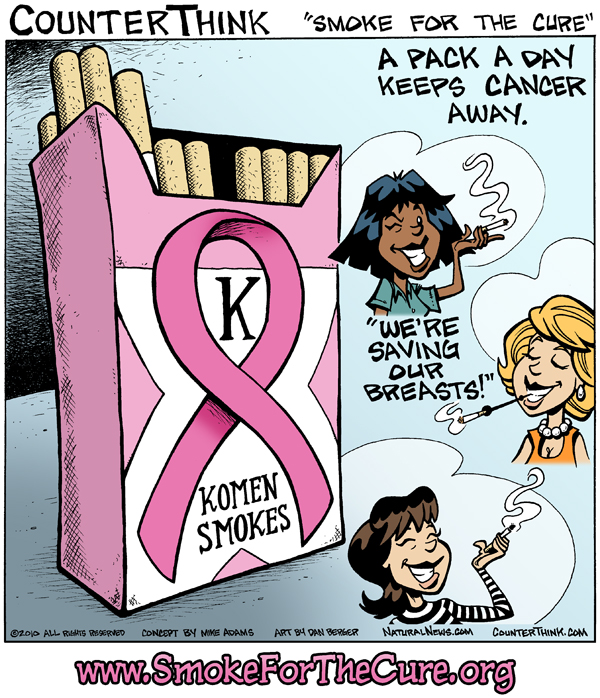
    In keeping with this month’s theme of breast cancer prevention, we offer this view of “The Little Pink Ribbon” campaigns by Mike Adams of www.NaturalNews.com – Mike has some insightful thoughts to share on this subject.

    Click on the cartoon to read more on the subject by Mike.

  • Bogus Breast Cancer Research

    Bogus Breast Cancer Research


    (Why the Little Pink Ribbon Has Me Seeing Red)


    By Dr. Dana Myatt


    October is “Breast Cancer Awareness Month,” and little pink ribbons are as plentiful as Halloween candy.

    Have you ever given money to breast cancer research or purchased a “little pink ribbon” to show your support and solidarity? If you have, I believe you’ve been duped by Big Pharma’s and Big Government’s bogus “research projects,” and thrown good money toward a losing game.

    Before you shoot the messenger, let me explain why the “little pink ribbon” has me seeing red.

    Problems with breast cancer fund-raising and research:

    1.) Money often doesn’t go to actual research.

    As much as 90% of revenues can be spent on “administrative” and “fundraising” costs. Depending on which charity your money goes to, the actual money generated for gifting can be less than 10%. That’s ugly.

    To find out which charities retain most of their revenues for genuine research contribution, check out your favorite charity at http://www.charitynavigator.org/

    For example, the Coalition Against Breast Cancer spends 78% of it’s budget hiring for-profit fundraisers:

    The American Breast Cancer Foundation spends 50% of it’s income on administrative and fund-raising costs:

    The United Breast Cancer Foundation spends 59% of revenues on admin and fundraising:

    And “Think Before You Pink,” a service of Breast Cancer Action, offers some additional tips and insider information about donating to breast cancer research:

    When you “give to the cure,” you might want to verify where your money is going and how much of it is actually being spent on breast cancer research.

    2.) Money funds more conventional cancer research, but conventional research, diagnosis and treatments are not improving cancer mortality rates significantly.

    I.) Conventional breast cancer treatments don’t work. At least not very well. Cancer research organizations that put money into Big Pharma are betting on the wrong horse.

    Despite press releases and proclamations which tell us that we’re “winning the war on breast cancer” (thanks, of course, to all of our collective millions of giving), the truth is that conventional cancer diagnosis and treatment have gotten us next to nowhere.

    According to statistics published by the National Cancer Institute, the breast cancer rate has declined 1.7% between 1998 and 2007. That, they say, is a “significant” change.(1)

    Of course, we are led to believe that this 1.7% drop is due to improvements in diagnosis (mammograms) and conventional treatment. But the statistics show otherwise.

    Instead, the single biggest drop in breast cancer rates of all time occurred in 2002-2003 when women flocked away from conventional hormone replacement therapy (HRT) after news “broke” that it increased breast cancer risk. According to the National Cancer Institute, breast cancer rates fell 6.7% — a heck of bigger drop than the 1.7% being touted —- when over 40 million women stopped taking conventional hormone prescriptions. (2) Actually, the association between HRT and breast cancer was known as early as the 1960’s. (3) For shame.

    In Canada, a 9.6% drop in breast cancer rates was noted when hormone replacement therapy use declined.(4)

    Whether it be a 6.7% or a 9.6% drop, that’s a much bigger improvement that our 1.7% “statistically significant” decrease claimed in the US as a result of millions of dollars of mammogram screenings and expensive chemotherapies.

    The single biggest drop we’ve seen in recent years in breast CA is when women flocked away from conventional hormone therapy in droves. In other words, the best thing that conventional medicine has done to stem the tide of breast cancer is to have women “just say no” to a breast-cancer causing conventional hormone treatment!

    So, the “significant” 1.7% decrease in breast cancer rates in over a decade includes the 6.7% drop in breast cancer due to women discontinuing conventional hormone replacement therapy. Instead of a new drug or surgical treatment being responsible for this modest decline in breast cancer rates, the decline is actually due to women avoiding a dangerous conventional drug.

    This also begs the question — if we are to believe that a 1.7% drop in cancer incidence is “significant,” how come the 2.7 increase between 1995-1998 was not also “significant”? And how come the 6.7% drop when millions of women stopped conventional HRT isn’t WAY significant? (1) Are we perhaps over-selling the “winning the war” statistics in order to give people a warm fuzzy and encourage them to keep contributing?

    II.) Much more is known about how to prevent cancer than how to cure it.

    Of the millions of dollars raised and donated to conventional cancer research, how come none of this money — nay, not even a little bit of it — is spent educating women on prevention? After all, an ounce of prevention really IS worth a pound of cure.

    Forget the measly 1.7% decline in breast cancer rates over the past 9 years, let’s talk about what is known about prevention. The preventive aspects of breast cancer, and how much the risks can be lowered, make the “statistically significant 1.7%” look even more ridiculous. Consider the truly huge improvements in breast cancer rates that could be achieved with known preventive measures.

    Overweight/obesity. Fat cells manufacture estrogen. We already know about the estrogen/breast cancer connection. The fatter a woman, the more breast cancer risk, at least for post-menopausal females. How big is this risk?

    Women who gain 55 pounds or more after age 18 have a 50% greater risk of breast cancer compared with those who maintained their weight. A gain of 22 pounds or more after menopause was associated with an increased risk of 18%, whereas losing at least 22 pounds after menopause and maintaining the weight loss was associated with 57% lower breast cancer risk. In case you missed this, let me repeat, a whopping FIFTY-SEVEN PERCENT DECREASED RISK by losing 22 pounds. (5)

    This is incredible news. Instead of putting pink ribbons on buckets of fast-food chicken, why aren’t these “concerned” cancer organizations telling women to back away from the fried chicken, shed a few pounds and drop their risk of breast cancer like a rock?

    Exercise. Invasive, estrogen-receptor negative cancers (less common, more deadly) can be reduced 55 percent by long-term, strenuous physical activity or 47% by long-term moderate physical activity. This amounts to 5 hours of exercise per week. (6) Let’s see…. a 47% drop compared to a 1.7% drop? “Long-term means you start exercising when you are a young woman and continue weekly exercise throughout life. Shouldn’t some of the “little pink ribbon” money be spent educating young women about the profound reduction in cancer risk from a modest amount of exercise, instead of just selling annual mammogram screening?

    Even if you didn’t start exercising as a younger woman, it’s never too late to benefit. In one study from the Women’s Health Initiative (WHI) as little as 1.25 to 2.5 hours per week of brisk walking reduced a woman’s risk by 18%. (7) Let’s see…. 18% vs. 1.7%. Did you hear any of this from the “little pink ribbon” sponsors?

    Alcohol contributes a small additional risk. Women who drink 2-5 drinks per day have 1 1/2 times the risk as non-drinkers. The effect is magnified in women who use conventional hormone replacement therapy. (8) This amounts to a small increase in risk, but remember — all the millions of dollars of “little pink ribbon” money have amounted to only a small decrease in risk.

    3.) Why should you and I fund Big Pharma’s search for newer, deadlier, ineffective drugs that they are going to profit from? Fund your own darned drug studies I say …

    Alrighty, so you run your butt off in a “race for the cure,” to raise money to assist drug companies in researching more drugs. Some of these drugs cost upwards of $10,000/month to the patient (while costing the drug companies a pittance).

    And then YOU get breast cancer. Do you get a discount because you helped Big Pharma fund a drug that might increase your survival by 8 weeks? NO. You, or more likely your insurer, will be paying full price for your treatment.

    Mike Adams sums this warped situation up succinctly:

    “For most diseases, the race for the cure is really just a way for drug companies to shift R&D costs to suckers. You fund the R&D, and then you get to pay full price for the drug they drummed up thanks to your generous donation. “ – Mike Adams


    Dr. Myatt’s Summary: millions of dollars spent over the last 3 decades and what do we have? A 1.7% reduction in breast cancer mortality. And most if not ALL of this decrease is due to declining use of conventional hormone therapy.

    On the other hand, we already know simple ways to slash breast cancer risk by up to 50%

    Until some of the “little pink ribbon” money goes toward public education about how to reduce risks, and some of the money goes to research non-toxic treatments, and until the “little pink ribbon” folks don’t whore their honor by allowing their icons on junk food, I’m keeping my money closer to home.

    _________________

    Find out more about the politics of breast cancer (and how Big Pharma and Big Government gain the most from our “fundraising efforts) here:

    http://bcaction.org/index.php?page=politics-faq#Funding%20for%20Breast%20Cancer%20Research

    _______________________________
    References

    1.) Altekruse SF, Kosary CL, Krapcho M, Neyman N, Aminou R, Waldron W, Ruhl J, Howlader N, Tatalovich Z, Cho H, Mariotto A, Eisner MP, Lewis DR, Cronin K, Chen HS, Feuer EJ, Stinchcomb DG, Edwards BK (eds). SEER Cancer Statistics Review, 1975-2007, National Cancer Institute. Bethesda, MD, http://seer.cancer.gov/csr/1975_2007/, based on November 2009 SEER data submission, posted to the SEER web site, 2010. http://seer.cancer.gov/statfacts/html/breast.html#incidence-mortality

    The joinpoint trend in SEER cancer incidence with associated APC(%) for cancer of the breast between 1975-2007, All Races Female

    Trend Period

    -0.5 1975-1980

    3.9* 1980-1987

    -0.1 1987-1995

    2.7 1995-1998

    -1.7* 1998-2007

    If there is a negative sign before the number, the trend is a decrease; otherwise it is an increase. If there is an asterisk after the APC then the trend was significant, that is, one believes that it is beyond chance, i.e. 95% sure,

    2.) NCI website accessed 10-26-10:

    http://www.cancer.gov/newscenter/pressreleases/2007/breastincidencedrop

    3.) McCarthy JD. Influence of two contraceptives on induction of mammary cancer in rats. Am J Surg. 1965 Nov;110(5):720-3.

    4.) Breast Cancer , accessed 10-26-10: http://www.breastcancer.org/symptoms/new_research/20100924.jsp

    5.) Morimoto LM, White E, Chen Z, et al. Obesity, body size, and risk of postmenopausal breast cancer: the Women’s Health Initiative (United States). Cancer Causes Control. Oct 2002;13(8):741-751.

    6.) NCI website accessed 10-26-10:

    Ref: http://www.cancer.gov/aboutnci/ncicancerbulletin/archive/2008/102108/page8

    7.) http://www.cancer.org/Cancer/BreastCancer/DetailedGuide/breast-cancer-risk-factors

    8.) http://www.cancer.org/Cancer/BreastCancer/DetailedGuide/breast-cancer-risk-factors

  • Neurotransmitters: Not So Simple…

    Neurotransmitters: Not So Simple…

    There’s a reason doctors go to school for so long!


    By Nurse Mark


    There’s a very good reason why people like Dr. Myatt have studied for years and continue to study every day – the human body is an incredibly complex and subtle organism.

    No one lay book, no matter how popular or compellingly written, and no amount of internet searching when done by someone without a very solid knowledge of biochemistry, organic chemistry, physics, normal anatomy and physiology, neurology, endocrinology, psychophysiology and pathophysiology is going to provide much more than confusion for most lay-people.

    Without such knowledge a “Ph.D from the University of google” is more of a hindrance than a help – for remember; just because it is written does not mean it is accurate or true, and just because some author uses seventy-five-cent words and pseudo-scientific terms liberally in his or her writing doesn’t mean that he or she really understands what they mean or is actually qualified to use them!

    Neurotransmitters are an excellent example of this complexity: Your gut and your brain are more intimately intertwined than you might imagine. 80% of a normal person’s serotonin is found in the gut, and any pathology that affects the gut can easily upset the delicate balances of serotonin in the gut, in the platelets of the blood (where it plays an important role in hemostasis and blood clotting), and in the serotonergic neurons of the nervous system.

    So, as you can see, even the most apparently simple question about neurotransmitters quickly becomes complicated – this one ties together three complex systems!

    Lori has been doing her very best to learn all she can about the neuroendocrine system as well as the digestive system – each no small feat by itself – and then to apply her new knowledge to herself and her maladies. She wrote recently to ask:

    When I take the 5-htp, I get very sleepy.  Great right before bed, but I bought it to raise my serotonin levels, and I cannot take it during the day. I am only taking less than 50 mg of the 5-htp. Should I take tryptophan instead? I need to raise my serotonin levels PLEASE HELP!!

    Dr. Myatt replied:

    Hi Lori,

    Congratulations! If L-5-HTP is making you sleepy, then this means it is working for you.

    HTP is the direct precursor to serotonin, endorphin, melatonin, nor-epinephrine and dopamine production.

    Click here to learn more about it’s effects: http://www.drmyattswellnessclub.com/l5htp.htm

    Tryptophan converts to L-5-HTP which converts to the above-listed hormones. This means that tryptophan would also make you sleepy.

    Continue to use your L-5-HTP but take it in the evening. That way, your “sleepy” effect will just help you
    get a better night’s sleep while you continue to enjoy the other neurotransmitter benefits!

    In Health,
    Dr. Myatt