Author: Wellness Club

  • Mediterranean Diet – Better, Or Just Less Bad?

    … And The Diet Wars Continue …


    By Nurse Mark


    With the publication of the latest installment in The Diet Wars, The New England Journal Of Medicine has provided the news media and diet advocates of all persuasions fresh fodder for argument.

    So far, the majority of news articles are favoring the Mediterranean Diet as being the salvation for mankind without really explaining why, except to suggest that red meat and dairy products are “limited.”

    Some examples of headlines gushing about the newest report are:

    • New Study Says Mediterranean Diet Reduces Heart Disease
    • Whip out the olive oil and toss the butter, french fries, and sugar
    • Mediterranean diet cuts risk of stroke
    • Mediterranean Diet Good for the Heart: Study
    • Mediterranean Diet Fights Heart Woes
    • The Mediterranean Diet: The New Gold Standard?

    Wow – how could any person in their right mind not want to give up red meat and dairy?

    Well, a very few sources have taken a more balanced look at the report – the Los Angeles Times penned this headline:

    Mediterranean diet, with olive oil and nuts, beats low-fat diet

    and reported in their article:

    In a head-to-head contest, a Mediterranean diet, even drenched in olive oil and studded with nuts, beat a low-fat diet, hands-down, in preventing stroke and heart attack in healthy older subjects at high risk of developing cardiovascular disease.

    They almost got it right!

    Yes, this was a head-to-head contest between two versions of a Mediterranean Diet and a low fat diet.

    Yes, the two versions of the Mediterranean Diet featured large amounts of olive oil and nuts – both items considered a no-no in “low fat” diets.

    Yes, those on the two versions of the Mediterranean Diet fared much better than those on the low fat diet.

    No, the participants in the study were not “healthy older subjects.”

    According to the authors of the study “Primary Prevention of Cardiovascular Disease with a Mediterranean Diet” which was published February 25, 2013 in the New England Journal Of Medicine the subjects did not have cardiovascular disease, but they were at high risk for developing cardiovascular disease:

    Eligible participants were men (55 to 80 years of age) and women (60 to 80 years of age) with no cardiovascular disease at enrollment, who had either type 2 diabetes mellitus or at least three of the following major risk factors: smoking, hypertension, elevated low-density lipoprotein cholesterol levels, low high-density lipoprotein cholesterol levels, overweight or obesity, or a family history of premature coronary heart disease.

    Here’s my take on this report:

    The “Mediterranean Diet” – a true “Mediterranean Diet” – will always win out over a “low fat diet,” and this report offers further evidence of that.

    Indeed, the authors of the study say the same in their conclusion:

    Among persons at high cardiovascular risk, a Mediterranean diet supplemented
    with extra-virgin olive oil or nuts reduced the incidence of major cardiovascular
    events.

    But is the “Mediterranean Diet” really the “best” diet to follow?

    Maybe. Maybe not. It depends on what you are calling a “Mediterranean Diet.”

    I wrote about this a while back in a HealthBeat News article titled The Mediterranean Diet – Is It All It Claims To Be?

    That article is worth a timely re-read since we are going to be bombarded with popular news media reports on this subject over the next little while.

    Here is some of what I had to say in that HealthBeat News article:

    I cringe whenever I hear someone tell me that they are “on the Mediterranean diet” because it allows them to eat “lots of pasta and couscous and hummus on pita and bread dipped in olive oil” and drink lots of wine – though they often qualify that by saying they’ll choose white wine “because it has fewer calories.”

    Feeling pious because they are eating copious salads and fruits and low-fat foods, these people invariably have simply modified their traditional western diet to include parts of what they believe might be Mediterranean cuisine (the parts that appeal to them, like pasta, bread, hummus, rice..) and they end up with a “diet” that is neither particularly healthy nor very nutritious.

    So, the bottom line. Is the Mediterranean diet really all it’s cracked up to be?

    For someone willing to adopt the Mediterranean diet as the lifestyle that it really is – that is, a highly physically active lifestyle of daily labor, meals of predominantly locally-grown and minimally processed foods, avoidance of processed foods, convenience foods, concentrated sugars, additives, preservatives, soft drinks and “snack foods”, and replacement of butter and processed oils and fats with minimally processed olive oil the answer is a resounding “yes” – the Mediterranean diet  as a “lifestyle” is indeed healthy.

    For someone who simply wants to “cherry pick” the attractive parts of Mediterranean cuisine such as pasta, rice, hummus, baklava, and sweet breads and then add them to a junk food filled western diet of sodas, processed foods, concentrated carbohydrates, and trans-fatty fast food while continuing to live a sedentary lifestyle the answer is “no” – it is simply a self-deluding recipe for health disaster.

    So, the take-home messages?

    Don’t be fooled – low fat diets are not healthy!

    Re-Read The Mediterranean Diet – Is It All It Claims To Be? so that you know what the Mediterranean Diet is – and what it isn’t.

    Take the headlines you see in the popular media with a grain of salt – they may have an agenda of their own, or may be just sloppy in their reporting. Find the original study and read it.

  • Is It Better Butter Or Badder Butter?

    By Nurse Mark


    Everybody knows that saturated fats will give you a heart attack – right? Why, even just looking at saturated fats can clog your arteries. And butter? Eek! That stuff will kill ya! Why take a chance, eating something as dangerous as butter, when there are nice, safe, healthy, polyunsaturated margarine spreads out there that you can buy?

    After all, everyone knows that mankind really was meant to chow down on concentrated plant fats like cottonseed oil, rapeseed oil, safflower oil, flax oil, corn oil and others. Why, the oil just fairly drips out of those plants, right? It doesn’t? You mean that you have to process the heck out of all those plants to get that oil? Who knew?

    OK, Ok… I’ll stop being so sarcastic now…

    My recent HealthBeat News article Fake Eggs And Other Food Fads drew some flak from folks who would have us abandon all animal-based foods in favor of a vegetarian or vegan lifestyle. Our evil carnivorous dietary advice would bring illness, misery and premature death to our readers they said – and it would be all our fault!

    Well, hot off the medical presses is an article published in the British medical Journal (The BMJ) with the rather dry and imposing title of:

    “Use of dietary linoleic acid for secondary prevention of coronary heart disease and death: evaluation of recovered data from the Sydney Diet Heart Study and updated meta-analysis” – published 5 February 2013.

    Here’s the “short course”:

    The Sydney Diet Heart Study was a single blinded, parallel group, randomized controlled trial conducted from 1966 to 1973 that involved 458 men aged from 30 to 59 years with a recent coronary event (i.e.: “heart attack”). Their diets were modified by replacing butter with omega 6 polyunsaturated margarine.

    (Remember all that stuff I wrote about assessing research in The China Study. Again… ? Well, “single blinded, parallel group, randomized controlled” means it was a well-done study.)

    Researchers thought that they would see an improvement in health in the men who were using the polyunsaturated margarine – after all, everyone knows that margarine is healthier than butter, right?

    But here is what the researchers actually found: The margarine eaters had higher rates of all cause death, cardiovascular disease, and coronary heart disease than the butter eaters.

    Yikes! As the Chrysler car ad for the 1993 Dodge Intrepid said: “This changes everything!”

    Here are their conclusions from the study:

    Advice to substitute polyunsaturated fats for saturated fats is a key component of worldwide dietary guidelines for coronary heart disease risk reduction. However, clinical benefits of the most abundant polyunsaturated fatty acid, omega 6 linoleic acid, have not been established. In this cohort [study], substituting dietary linoleic acid in place of saturated fats increased the rates of death from all causes, coronary heart disease, and cardiovascular disease. An updated meta-analysis of linoleic acid intervention trials showed no evidence of cardiovascular benefit. These findings could have important implications for worldwide dietary advice to substitute omega 6 linoleic acid, or polyunsaturated fats in general, for saturated fats.

    If you are reading that the researchers say that “worldwide dietary guidelines” are wrong, then you are reading the conclusion exactly the same way I am.

    You can read the full study here

    Go on – enjoy your butter. It looks like maybe it’s that so-called “heart-healthy” polyunsaturated vegetable oil margarine that’ll kill you!

  • The China Study. Again…

    By Nurse Mark


    There are some arguments that will never end.


    Republican versus Democrat. Ford versus Chevy. Pepsi versus Coke. Red Sox versus Yankees. These ongoing debates tend to assume a stridency and fervor that one might expect from a religious debate like Judaism versus Islam.

    Indeed, adherents to either side of one of these arguments can become so emotionally invested in their “righteousness” that they can be moved to verbal and even physical violence. Even something as silly as the Ford versus Chevy debate has led to bloodshed, and we know only too well where religious differences have led mankind over the course of our history!

    So it is no surprise that there are deeply entrenched adherents who support and defend dietary arguments with the same fervor and intensity and emotion as arguments about religion or politics. Or Fords versus Chevys.

    There are vigilant souls ever ready to leap vociferously to the defense of their chosen dietary regime. Many are respectful, polite, and well-meaning, while others quickly degenerate in their defensive arguments to name-calling, insulting, and even threats.

    We get plenty of “helpful” emails from those who disagree with our writings, seeking to tell us how wrong we are and why, telling us we must read their favorite book, watch a video, or talk with their messiah who will surely convert us to the “right” way of thinking. The respectful, polite, and well-meaning ones we will usually do the courtesy of reading, sometimes even replying to. The name-calling, insulting, and threatening ones respond nicely to the “delete” key.

    One thing that Dr. Myatt and I have found is that most of the people who contact us in hopes of converting us to their point of view could, as one research scientist and friend of ours put it, “be tied to a tree and have irrefutable scientific evidence paraded before them and yet remain unmoved in their opinion!” These people usually respond to contrary evidence with “yes, but…” and often go on to relate testimonial “proof” of the correctness of their position. Sometimes they’ll just insult us by telling us that we only think the way we do “because you are prejudiced” or that we are simply ignorant of the “true facts.”

    By the way, the modern, politically correct way to call someone ignorant nowadays is to tell them that they are “low information” – as in “low information voters.”

    We know that we will never, ever be able to pry such people free of their beliefs, and to be honest, we are not really trying to. We will simply point out why we adhere to our beliefs, and we feel that if we are going to express those beliefs publicly we should offer scientific proof for them. That is why when you look at product pages on our website you will not see glowing customer testimonials about products. A testimonial is an opinion, not proof.

    Even “scientific studies” often do not constitute “proof.” Scientific studied must be approached with caution: the first question to ask is “was this an observational or interventional study”? Did someone just gather up a bunch of statistics, massage the numbers, and reach the conclusion that supported their theory or hypothesis? Was the study done on humans, lab rats, or in a test tube? Who funded the study, and why? Who profits from the results of the study?

    On Vegetarians, Vegans, Animal Rights Activists, and The China Study…

    Regular readers know that Dr. Myatt recommends a low or very-low carbohydrate diet. This is based on personal experience, decades of clinical experience, and scientific research and study all of which have provided us with reason to believe that a low to very low carbohydrate diet is probably optimal for health in most humans.

    Note that I said “reason to believe” and not “proof.” Neither personal experience nor clinical experience constitute “proof” – they are testimonial evidence that provide support. Only a preponderance of evidence, scientifically obtained and peer-reviewed, supply “proof” and even that can be open to change in some cases.

    “Figures Lie, and Liars Figure”

    I can hear my grandfather’s voice when I write those words, and they are as true now as they were then. Given a little time, creative semantics, and statistical manipulation, one can make statistical research “prove” almost any hypothesis. Just ask the drug companies – they are experts!

    Indeed, there are people who fervently believe that the earth is flat and who will provide all manner of mathematical and geometric “proof” to that effect. Are they right? Maybe, but personally I doubt it.

    Others will trot out “research” to support their contentions.

    Sometimes this research is little more than finding and quoting the same lab-rat study that they found quoted in several dozen, or hundred, or thousand locations on the internet with a Google search.

    There are “observational” studies: The researchers observe something, for example lifestyle habits of a certain population, and make conclusions from that. “The people of Outer Elbownia are more active than the people of America. Active people live longer lives” The problem here is that there are a whole lot of other differences between the two populations – perhaps the Outer Elbownians don’t have cars and that’s why they are more active. That would also mean fewer of them are killed in auto accidents. Or perhaps they are less affluent and drink less soda pop and junk food. “We observed that every morning the rooster crows and then the sun comes up – so we conclude that the crowing of the rooster makes the sun rise in the morning” is another example of an “observational study.”

    Some will refer to a study done without adequate controls or on a very small population. This is the “12 patients were fed XYZ for a week and all lost weight” kind of study. It’s interesting, but far from proof of anything.

    Then there are the “retrospective” studies: “10,000 middle aged women were asked to describe what vitamins they took over the last twenty years.” Can you see where there might be a problem with a study like this?

    Then there are controlled, “interventional” studies: “500 men, aged 45 to 55 years, were fed XYZ supplement while eating a controlled diet and living and working and exercising in a controlled way for X months, and XX percent of those men demonstrated a change of X amount as measured by XYZ objective technique.” Whew! – Now we’re getting somewhere. There is enough information there to be able to assess the results. But is is still not “proof.”

    For something closer to “”proof” we would take two groups of 500 men and have them do everything the same except that one group would get the XYZ supplement and the other would get a placebo, but no one would know which they were getting. That is called a “placebo-controlled study” and comes closer

    To get even closer, you would then switch the two groups around. And assign supplement/placebo randomly within the groups, and ensure that those tabulating the results did not know and could not skew the results, and on and on. There is an entire science devoted to the science of performing research of this kind.

    The very closest we get to “proof” of something however is when different, unrelated researchers perform separate studies using the same basic parameters as other studies – that is, similar study populations, similar circumstances such as diet, exercise, and environment, and similar drug, diet, treatment, or supplement studied. If a bunch of similarly conducted studies by unrelated researchers all reach similar conclusions, then we have something approaching proof.

    Massaging statistics does not make proof.

    Murders and sales of ice cream are both more common in the summer months. Does this mean that ice cream causes murders? Correlation does not equal causation. It is the basis for forming a hypothesis, not a conclusion.

    Finally, there is something called “Observational Bias.” This is where someone already has a belief or opinion and will tend to look less critically at a studies or research that agrees with their belief. As in: “I believe that big, heavy automobiles are safer – and this study commissioned by the Big, Heavy Car Association agrees with me, so it must be true.”

    So We Come To The China Study

    We have written about this before – this has been a popular book for those who wish to believe that their vegetarian or vegan dietary habits are superior to those of omnivors or meat-eaters and feel that it provides plenty of “ammunition” for their arguments to impose their dietary beliefs on others.

    One of Dr. Myatt’s readers wrote recently:

    My husband is really fighting me about eating meat. He keeps referring to The China Study and how bad meat protein is – organic or not. I do feel bad about cooking meat at home because it does smell good and will influence him to want to eat it also, which goes against his belief system now. What advice do you have or information that can help my case?

    And Dr. Myatt replied:

    The China Study has more holes in it than a kitchen colander. I can’t enumerate all the problems — it would take a book. But here are two of the most important points.

    1.) This was an “observational study,” which never proves anything. “The rooster crows and then the sun comes up — therefor the rooster crowing is what caused sunrise…”

    Observational studies can give us ideas to test in interventional studies. Since we observed the rooster crowing / sunrise phenomenon, we silence the rooster and see if the sun comes up without his help. It still does. Our original observation that the rooster crowed and then the sun rose was correct, but our extrapolation that the crowing rooster caused sunrise was wrong. And so it is with many of the observations in The China Study.

    2.) Data presented in the book often do not support the conclusions. For example, data presented in the book do not show statistically significant correlations between animal protein consumption and diseases such as cancer. Just the opposite. It appears that sugar and carbohydrates are highly correlated with cancer.

    The data show that fat is negatively correlated (meaning “protective against”) cancer. That contradicts the claim that meat is harmful, since meat is a primary source of fat.

    The long list of what is wrong with The China Study has been covered well by Dr. Michael Eades on his blog.

    If you are interested in learning more about this travesty of good science, Read More Here.

    I don’t know what else to tell you regarding your husband not wanting you to eat meat. His opinion on this, in MY opinion, ill-informed. And if he’s truly “against” eating meat, then the smell of your steak shouldn’t be a temptation for him. It should smell bad to him since he believes it is bad.

    If you lose weight, lower cholesterol and / or blood sugar levels, have better skin tone or anything else good, then you’ll see that clean meat is a health food, not the villain that some people mistakenly believe.

    Then more recently, in response to my article Fake Eggs And Other Food Fads Aaron wrote to take me to task for being obviously unfamiliar with the information contained in The China Study and in Dr. McDougall’s website:

    You could not be more wrong.
    Read Campbell and Campbell’s section on Affluent Diseases in The China Study or talk to Dr. John McDougall in Santa Rosa, CA via his web site.
    Aaron

    Well Aaron, I am rather familiar with the content of both those things. I have some serious problems with The China Study, especially with the way conclusions were drawn in the Affluent Diseases chapter, and I am very clear about Dr. McDougall’s crusade to end the consumption of animal-based foods.

    I respect Aaron’s beliefs though, and and those of his hero Dr. Mcdougall. I would never try to persuade them that they should eat animal protein. That would only offend them and frustrate me

    Granddad had a saying about that too: “Never try to teach a pig to sing; it wastes your time and it annoys the pig.”

    I won’t spend any more time here rebutting The China Study – I have done so before, Dr. Myatt has given her thoughts on it, and there are others who have addressed the shortcomings of the book in far more detail and precision that I have time or patience for. In addition to reviewing the writing of Dr. Michael Eades on the failings of The China Study, there is an extremely well-written and heavily referenced formal rebuttal by Denise Minger that can be found here.

    Oh, by the way… The China that Colin Campbell’s “The China Studypraises so highly for it’s “healthy” avoidance of animal protein in the diet? That the book fans point to as evidence of the righteousness of a plant-based vegetarian diet?

    Did you know that China is the world’s largest producer and consumer of pork? That the average Chinese eats about half a grown hog each year? Or that China ranks 3rd in the world for beef consumption?

    Really… Who knew!

    Do I hear a “Yes, but…”

  • The Not-So-Golden Years, Insurance, Priorities, And A Nice Little Truck

    By Nurse Mark


    Regular readers know that Dr. Myatt and I are RV’ers, traveling in our coach to speak and lecture.

    We get to meet folks of all ages from all walks of life, but I must admit that the majority of folks we meet in RV parks are “mature” – retired, older, sometimes a lot older, and often with multitudes of medical woes to relate. That’s no surprise really, for anyone who has sixty, seventy, eighty, or ninety years of experience is bound to have an ache or pain or complaint or two.

    What never ceases to amaze us though is the near-total complacency of many people with their medical situations and overall health.

    So many seem quite content to see their conventional “insurance” doctor every six months or so for their 8 minute “checkup”, blurt out their litany of complaints, and meekly accept the hastily scribbled prescription for yet another drug to be added to the growing list of daily pills. Then it’s off to the pharmacy to buy the magic pills, and then home to resume life as usual, firmly convinced that they are “doing everything possible” for their health.

    Once back in the company of their friends (or anyone who’ll listen) they regale all within earshot with their medical hard luck stories, complete with descriptions of surgeries, diagnoses, drugs, treatments, and even lab results. There is often a sense of “one-upmanship” to some of these round-table “discussions.”

    The interesting common thread in these stories is that all these things are being done to them – not by them. There really isn’t much interest in taking responsibility for their own health beyond seeking out a doctor who will bill their insurance and order tests, drugs, treatments, or surgeries which the victim patient blithely accepts.

    For example: “Joe” was a nice enough fellow we parked next to. Joe was puttering and as I hooked up our RV we began to chat. The conversation turned to his health (as it often does when people see the Big Red Apple and Dr. Myatt’s name on our coach) and Joe launched into a recital of his litany of medical troubles – pills for his diabetes, pills for his blood pressure, pills for his cholesterol, pills for his heart, pills for his water, pills for his heartburn, and pills to put himself to sleep at night.

    Joe had undergone a bunch of surgeries, for a variety of complaints – none of which seem to have done much good – but he was seeking yet another surgery in the hopes it would ease his aching back.

    “At least,” he boasted, “I’ve got good insurance – otherwise I could never afford all this and I’d just have to suffer!”

    But as Joe talked I could hear bitterness in his voice at a medical system that he felt was failing him in what should be his “golden years.” Having “worked hard and paid taxes” he felt that modern medicine only wanted to “push more pills” on him and his insurance plan wanted to make him “wait until I’m a cripple” for his desired surgery.

    I was curious and asked Joe a few questions:

    Did he take any vitamins or supplements? No, his doctor told him those were useless – they would only give him “expensive urine.” Besides he said, all that “natural stuff” wasn’t covered by his insurance; he’d worked hard for that insurance, so why should he have to pay good money out of pocket for something? If that stuff was worth anything the insurance plan would pay for it, right?

    Hmmm… I wondered how expensive his urine is with all those prescription drugs?

    I asked did he do any exercise? Yep, he said proudly, golfing keeps him in pretty good shape, except he gets “kinda out-o’-breath” walking from the golf cart to the tee sometimes if he has to park too far away. His aching back kept him from doing any “heavy exercise” though, and besides; his doctor had told him he should “take it easy” and “don’t over-do it” on account of his heart problems. This, from a man with skinny legs and arms and a drum-tight carbohydrate-induced pot-belly that made him look about 8 months pregnant with twins…

    Hmmm… I wondered if that belly had anything to do with the aching back or shortness of breath?

    What about diet? I asked (knowing already what the answer would be)… Well, he said, his doctor sent him to a dietitian who told him to follow the ADA approved “Diabetic Diet” – and he thought that was working pretty well except he got “low blood sugar” a lot and needed to have a mid-morning snack to keep him from feeling jittery and a mid-afternoon nap because he was always so sleepy after lunch…

    But he said his wife fed him “real healthy” with oatmeal at breakfast, whole wheat bread in his lunchtime sandwich, and potatoes or rice or beans or pasta (whole wheat of course!) for supper – just like that ADA diabetic diet said.

    They had given up beef because they heard it causes cancer, and everything he ate was low fat because his doctor told him his cholesterol was too high. He avoided protein because someone said it was “bad for the kidneys” and besides, he needed the bread and potatoes and pasta “to fill up on.”

    As a “Child of The Depression” he had memories of hunger during those years and sometimes he would “cheat” on his diet – but if he did that he would just take an extra pill… After all he said, his insurance plan paid for his medicines.

    Hmmm… I wondered if all that ADA-approved carbohydrate might be keeping him a diabetic?

    I gave up on the health questions at this point – I’d heard enough and was feeling discouraged for him.

    Joe was meticulously polishing an immaculate 4 wheel drive pickup truck that he pulled behind his sparklingly beautiful motor coach – both were obviously a great source of pride for Joe so I asked him about the pickup.

    He told me how it was a few years old now, but he had taken “real good care” of it since new – he serviced it and changed the oil regularly, even more often than the manual called for. He washed and polished it at every stop. He rotated the tires regularly to keep them from wearing unevenly. Nothing but the best fuel and oil were ever allowed – no “cheap stuff” for this little truck, and a fuel additive went into the tank with each fill-up to keep the fuel system clean.

    Always driving carefully, never harshly or abusively, he said he made a point to take it out on the highway every week or so “to blow out the carbon and keep it running smooth” and carefully drove off-road in 4 wheel drive at least once a month as directed in his manual to keep the drivetrain lubricated and “exercised.”

    He told me how he had a buddy who had a similar truck with several hundred thousand miles on it, and he was aiming to better that record by taking even better care of this truck – he just knew he could do it even if sometimes he had to budget carefully to pay for the extra maintenance.

    I wished Joe good luck and we went our separate ways – him to relax with a smoke and a lite beer after his hard work of polishing and cleaning, and me to exercise the dogs (and me) who had been cooped up for a few hours as we drove.

    I thought about Joe, and about how many are like him.

    Joe knows how to keep his truck in the peak of health and fitness – and as things stand now, it will easily outlive him.

    If he would only apply the same techniques to himself he might easily live long enough to outlast several trucks.

    But alas, while Joe doesn’t mind paying out-of-pocket to maintain that little truck, the thought of paying out-of-pocket to maintain his own health offends him.

    Why can’t Joe and folks like him take responsibility for their own health the same way they do for their other possessions?

    Isn’t good health our most important possession?

    Why will folks pay more to maintain their vehicles, their stock portfolios, or their hobbies than their health?

    With some good integrative health advice, good food, good optimal dose vitamins and supplements, regular exercise, clean air and clean water, and regular detoxing to look after the inevitable toxins of daily life – Joe could probably throw away the pills and add happy, active decades to his life.

    But I’m guessing that won’t happen.

    For people like Joe it’s far easier to make personal health the responsibility of a pill-pushing, scalpel-wielding, insurance-billing doctor.

    Too bad – but maybe I’ll be able to buy that nice little truck from Joe’s estate…

  • Fake Eggs And Other Food Fads

    By Nurse Mark


    Fads have been with us forever – it’s just human nature to want to “jump on the bandwagon” when something new and catchy comes along.

    Dancing the Charleston. Zoot Suits. Troll dolls and Beanie Babies. UFOs. Rubik’s Cube. Hula Hoops. Poodle Skirts. The Macarena and Disco dancing. All these and more have come, and gone. Most are not missed in the least.

    Medical fads come and go too: doctors are no more immune to the lure of “jumping on the bandwagon” than anyone else, and for doctors there can be an important incentive to follow along with their colleagues since not following the herd exposes them to the risk of being accused of not providing “standard of care” – which risks their license. Some notable medical fads include prescribing antibiotics at the first hint of the sniffles, prescribing cholesterol-lowering drugs for almost any reason, prescribing “bone building” drugs despite the known dangers, and on and on.

    Dietary fads come and go as well – often with help from the medical industry. For a number of years now it has been popular for doctors to tell patients to “avoid salt,” “cut out the fatty foods,” “stay away from cholesterol,” “avoid red meat,” “reduce your coffee intake,” and other such silly advice rooted in faulty biochemistry.

    Big industries love these medical and dietary fads – for they can use them to advantage to sell stuff. Everything from prescription drugs to chicken-instead-of-beef to “low sodium” / “low fat” / “low cholesterol” manufactured foods is fair game for their marketing departments and as a result we are constantly bombarded with a cacophony of shrill and conflicting claims.

    One of the most enduring and possibly most harmful of the medical / dietary fads is the low fat / low cholesterol fad.

    As regular HealthBeat News readers you know that essential fatty acids (aka “fats”) are essential to life, and that cholesterol is an important part of our good health – no matter how much we do or don’t eat of it we must have it to live and so our livers make it for us de novo from other raw materials if we don’t get enough in our diet.

    We have written about this subject over and over in HealthBeat news: Do Eggs Really Cause Blocked Arteries? and Saturated Fats: Another Big Fat Lie are two articles worth re-reading.

    In an effort to cater to these fads the Big Food Industries like ConAgra, General Mills, PepsiCo, Nestle, and dozens more all compete for consumer dollars with “manufactured” foods designed to meet the “needs” of consumers intent on following the latest food fashions.

    This redesigning of once-healthy foods brings us such things as margarine to replace butter, Crisco to replace lard, Egg Beaters to replace real farm-fresh eggs, “low fat” cheeses of all descriptions, foods boasting to be “no saturated fats” and “cholesterol-free,” imitation meats, and “low calorie” foods galore.

    But these things are all good for us, right? After all, the doctors all say so… and so do the big industries promoting them – often with a wink and a nod from Big Government.

    Let’s look at one of these fads and the “foods” that have been developed to go along with it.

    “Cholesterol is Bad For You!” and “Saturated Fats Will Give You A Heart Attack!”

    This fad began in earnest in the 1950’s, based on some really bad science that was then promoted by some very big industries. If you haven’t already done so, please go back and re-read Saturated Fats: Another Big Fat Lie for the back-story on this.

    It resulted in things like Mazola corn oil margarine, Synthetic butters, usually made of soy, cottonseed, or canola oils, Fat free “whipped cream,” fat free mayonnaise, “non dairy” coffee creamer, and the piece de resistance, an odd, not-quite-eggs product called “Egg Beaters” that promises to be just as good as real eggs, without all that nasty cholesterol. Crisco (CRYStallized Cottonseed Oil – formerly an industrial waste product) had been around for a lot longer – it just got a fresh life with this new fad.

    Now, let’s assume for just a moment that maybe fats and cholesterol really are bad for us, and that foods without fats and cholesterol therefor must be good for us. How could our heroic, hard-working scientists manage to create new foods that don’t have the bad ingredients but that can still taste good?

    Well, it isn’t easy, but given enough corn syrup, high fructose corn syrup (yes, they really are two similar but different things!), modified food starch, sugars of various descriptions, “edible” oils, flavorings (artificial or otherwise), and just the right industrial massaging such as hydrogenation – a rather intimidating process that usually involves heat, pressure, and a catalyst – normally a metal such as nickel, we get Faux Foods.

    Learn more about the process of hydrogenation here.

    When we look at the Nutrition Facts Box for any of these “food products” we usually see the same actors over and over: water, corn syrup, modified starch, casein, sugar, and of course hydrogenated oils. That, along with colorings, spices and other flavorings, and some chemicals and preservatives to keep it all together – and voila! You have a new food product! (And there are some that are not even allowed to call themselves food – look for one called “Smart Beat Healthy Fat Free Non Dairy Slices” – the words “food” and “cheese” don’t appear anywhere on the label!)

    Well, you say, what about those Egg Beaters? After all, the label says they are 99.99 percent real eggs!

    Yes, the label does say that. And the latest label information shows that Egg Beaters contains some 28 ingredients including “natural” flavors and colors, sulfites, vegetable gums and tocopherols (possible soy, wheat or corn allergen products), and ferric phosphate (iron).

    But in reality, what are we trading for this? The goodness of egg yolks! Folks, the egg is one of mother nature’s most nearly perfect foods. And if someone is allergic to egg, it is most likely an allergy to the egg white – the main ingredient of Egg Beaters! Please, if you are at all unclear about the bad rap that eggs have gotten and continue to get please re-read Do Eggs Really Cause Blocked Arteries? and get hip!

    Egg Beaters were introduced in 1972 in response to the “Cholesterol is Bad For You” fad that was really getting rolling then and was likely given to all sorts of unsuspecting groups such as infants, children, seniors, inmates, and other victims being fed institutional food. Many probably didn’t do well, so saner heads prevailed and studies were conducted – one of the most well-known of these was titled “Nutritional Value of Egg Beaters® Compared With “Farm Fresh Eggs” by Meena Kasmaii Navidi, Fred A. Kummerow. Published in 1974 by the American Academy of Pediatrics, The abstract can be found here. We have read the full article and can report that it is less than complimentary to Egg Beaters!

    Three groups of lab rats were used in the study: the rat mothers and their 2 to 3 day old pups were fed either whole hens eggs, Egg Beaters, or regular rat chow.

    From that paper:

    RESULTS
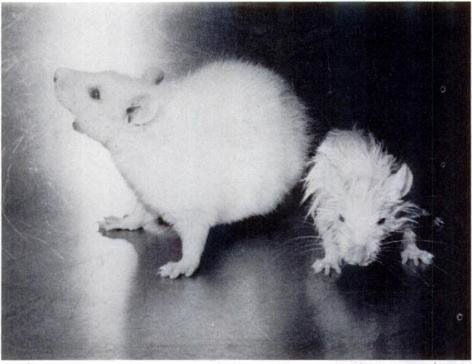
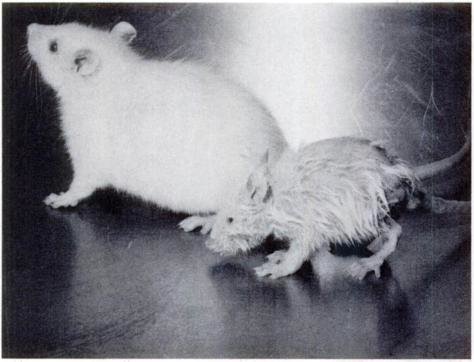
    The pups from the mothers fed Egg Beaters averaged 31.6 gm, and those fed whole egg averaged 66.5 gm in weight at 3 weeks of age as compared to 70 gm for pups from those fed laboratory chow. Both the mothers and pups fed Egg Beaters developed diarrhea within one week; those fed whole egg did not develop diarrhea. The pups fed the two egg mixtures were weaned at 5 weeks of age. All of those fed Egg Beaters died within three to four weeks after weaning. The general appearance of the rats fed Egg Beaters indicated a gross deficiency in one or more nutritional factors as compared to those fed whole egg ( Fig. 1) . As the animals had a tendency to become coated with the Egg Beaters, the animals were washed gently with a mild detergent solution and dried with paper towels. The washing removed some of the hair as well as the Egg Beaters ( Fig. 2).

    EggBeatersRat   EggBeatersRat2
    Fig. 1. Weanling rats fed shell eggs (left) or egg Beaters (right).   Fig. 2. Weanling rats fed shell eggs (left) or Egg Beaters (right). ( Both animals were washed with mild detergent, rinsed and dried with paper towels before picture was taken.)

    Are there any questions? Which rat pup would you rather be?

    To be fair, the ingredients list from the Egg Beaters of 1974 looks slightly different from the ingredient list of today, though the actual full ingredients list of today’s formula is a little hard to pin down. However, the authors of the 1974 study noted:

    A comparison of the nutrients in Egg Beaters with the nutrients in “farm fresh eggs”  indicates a list of nutrients which should be able to meet the growth requirements of weanling rats.

    Judging by the pictures, Egg Beaters definitely did not meet the nutritional needs of these rats!

    Coffee Mate is another pseudo-food manufactured especially for those who have been frightened away from all things fat. This concoction tastes great – and so it should; the stuff comes in some 25 flavors including gingerbread, Parisian almond crème, peppermint mocha and of course “original.”

    So, what’s in it? Well, all the varieties are slightly different, but here is the list of ingredients provided by Nestlé for “original liquid”: water, corn syrup solids, partially hydrogenated soybean and/or cottonseed oil, and less than 2% of sodium caseinate (a milk derivative)**, dipotassium phosphate, mono- and diglycerides, sodium aluminosilicate, artificial flavor, carrageenan.

    The first two ingredients (after “water”) are corn syrup and soybean and/or cottonseed oil. Why would someone would give up a nice, healthy, nutritious spoonful of heavy whipping cream in their coffee for this sugary chemical concoction?

    OK, so maybe I’m not being entirely fair by harping on those two fake foods – after all, they are an easy target.

    What about margarine you ask? Surely margarine can’t be bad – after all, it has been a staple in many homes for decades. Well, not so fast. Let’s look at margarine a little more critically.

    In the 18th century, looking ways to feed his army on the cheap, Emperor Louis Napoleon III of France offered a prize to anyone who could make a satisfactory substitute for butter, suitable for soldiers and “the lower classes.” Of course an enterprising chemist soon obliged him, and gave the world margarine. Early margarine was probably healthier than today’s concoctions – the principal raw material in the original formulation of margarine was beef fat. Shortages of beef fat during WWII led manufacturers to begin using vegetable oils like cottonseed and soy oils.

    Let’s ignore for a moment that when we use margarine we are turning our backs on a natural, healthy food – butter – and instead are ingesting oils that were never really intended for human consumption such as soybean, canola, cottonseed, or corn oils.

    Let’s ignore that in order to make these oils into a form that is somewhat butter-like (after all, that’s the goal – to imitate natural, healthy butter) they must be manipulated through some harsh industrial processes like hydrogenation.

    Let’s ignore the fact that margarine is naturally white and that either artificial or “natural” color must be added to make it look like butter.

    Here’s an eye-opener: margarine doesn’t taste like butter. That’s no surprise when you think about it – because it’s not butter.

    Why is that a big deal? Well, it’s a big deal because if you are a manufacturer trying to market a fake butter and it doesn’t taste like butter it isn’t going to sell very well!

    So, what do you do? You make it taste like butter. How do you do that? You add a chemical called diacetyl.

    Diacetyl is the stuff they put in microwave popcorn to give it that “buttery flavor” – the stuff that causes lung problems, remember? Repeated, long-term exposure to heated diacetyl can cause bronchiolitis obliterans, a rare and serious disease of the lungs – and the only treatment for that is a lung transplant. Learn more about diacetyl here.

    But wait you say – we’re not talking about microwave popcorn, we’re talking about margarine! Stay on topic here!

    OK – here’s the problem: diacetyl has been linked to Alzheimer’s disease.

    A 2012 study found evidence that diacetyl intensifies the damage caused by an abnormal brain protein linked to Alzheimer’s disease. The study appears in the American Chemical Society’s journal Chemical Research in Toxicology.

    Now, to be honest, diacetyl is present in butter too – it is part of what makes butter taste, well, like butter. It is also found in beer, and in wine, and cultured milk products like buttermilk. It is a natural product of fermentation.

    Did I just say “natural” ? Yes – diacetyl is a naturally occurring chemical. That means when the Nutrition Facts Box says something like “natural flavoring” that diacetyl may have been added. That, however, may not be quite so “natural”!

    Diacetyl is also an industrial chemical that is used as a mosquito repellent. I’m betting that the diacetyl used industrially is not the natural product of fermentation found in beer or butter – and I’ll bet that the diacetyl poured into the mix to make margarine isn’t “natural” either.

    Personally, I’m going to stay away from anything with diacetyl added to it – and that includes anything that says “natural butter flavoring added” – and I’ll stick with the diacetyl that Mother Nature gives me naturally in my butter and beer and Chardonnay.

    Well jeepers! you say – What a sorry state of affairs! But now even things as natural as beef and chicken aren’t so pure and healthy anymore, so you are going to be safe by avoiding them. There are some great-tasting, “all natural”, vegan-friendly meat substitutes available that are just as tasty as the real thing only so much healthier!

    Well kids, I’m sorry to pop your bubble on that idea – you may eat what you choose, but you won’t find me swallowing anything with an ingredient list similar to this popular chicken meat substitute:

    textured vegetable protein (soy protein concentrate, soy protein isolate, wheat gluten, water for hydration), water, enriched wheat flour (flour, niacin, reduced iron, thiamin mononitrate, riboflavin, folic acid), bleached wheat flour, corn oil, cornstarch, contains two percent or less of wheat starch, salt, methylcellulose, modified corn starch, dextrose, autolyzed yeast extract, potassium chloride, natural and artificial flavors from non-meat sources, sugar, maltodextrin, disodium inosinate, soybean oil, hydrolyzed soy protein, onion, paprika, dried yeast, inulin from chicory root, caramel color, tapioca dextrin, xanthan gum, sodium alginate, spices, yellow corn flour, paprika extract for color, annatto extract for color, baking soda, garlic, tomato powder, celery extract, wheat fiber, lactic acid, safflower oil, barley extract, citric acid, niacinamide, egg whites, nonfat dry milk, succinic acid, disodium guanylate, iron (ferrous sulfate), thiamin mononitrate (vitamin b1), pyridoxine hydrochloride (vitamin b6), riboflavin (vitamin b2), vitamin b12.

    Is it just me, or does that ingredient list typify everything unhealthy that could possibly be found in a fake food? Yes there are a few healthy ingredients in there – but why must we have chemists artificially providing them to us in an expensive industrially created “food substitute” when Mother Nature has been giving us her healthy and natural creations so safely and economically for so long?

    I’ll continue to enjoy real eggs, real cream, real butter, real lard, real meat, real cheese to go along with my real life.

    And oddly enough, perhaps because I avoid carbohydrates as much as possible, my cholesterol levels are just fine, thank you so much for asking!